
A customer came to Topnovo with a simple starting point: an existing plastic coffee cup and an idea to turn it into a more durable, reusable, and premium product.
Topnovo helped transform that concept into a 16oz / 450ml double-wall stainless steel custom coffee mug, taking the project through concept review, 2D and 3D design, 5-6 design revisions, two sample rounds, physical testing, and final production validation.
The development reached the approved sample stage in approximately 35 days. After that, a 100-piece trial batch was produced to verify manufacturability and consistency, and 4 finished units were sent to the customer for evaluation and testing.
This case shows what happens between “we have an idea” and “this product can actually be produced.”
Project at a Glance

| Item | Project Details |
|---|---|
| Starting point | Existing plastic coffee cup concept |
| Product developed | Custom stainless steel coffee mug |
| Final capacity | 16oz / 450ml |
| Material | 304 stainless steel inner + 304 stainless steel outer |
| Construction | Double-wall vacuum insulated |
| Design revisions | 5-6 rounds |
| Sample rounds | 2 |
| Trial production | 100 pcs |
| Customer test samples | 4 pcs |
| Sample logo method | Screen printing |
| Surface finish | Rubberized silicone finish |
| QC validation | Vacuum test and lid test passed |
| Development time | Approx. 35 days to approved sample |
The Challenge
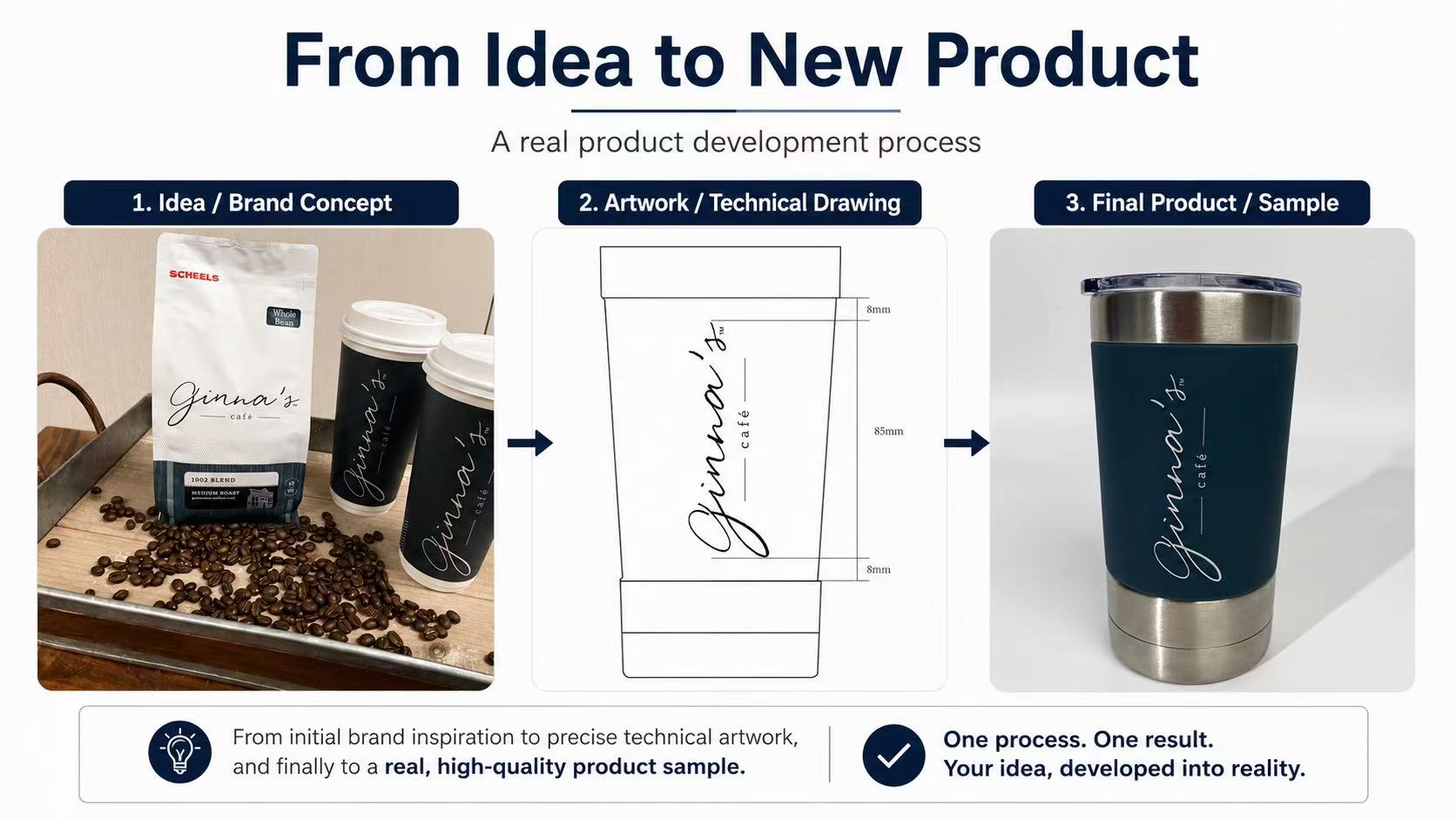
The customer did not come to us with a finished engineering drawing.
They had an existing plastic coffee cup as inspiration and wanted to develop something with a similar coffee-shop feel, but with better durability, higher perceived value, and stronger potential as a branded reusable product.
The challenge was not simply:
“Can we copy this cup in stainless steel?”
The real questions were:
- What capacity would make sense?
- How should the body proportions change when moving from plastic to stainless steel?
- Should the mug use single-wall or double-wall construction?
- What material should be used?
- How should the rim, base, logo, and lid work together?
- Would the design still be practical for repeat production?
- Could the product pass basic vacuum and lid validation before larger production?
This is where product development becomes more important than simply manufacturing an existing design.
At Topnovo, we help brands improve their drinkware business by turning ideas, sketches, reference samples, and market concepts into manufacturable drinkware products.
Choosing the Product Direction
After reviewing the original plastic cup, Topnovo recommended developing it as a double-wall stainless steel coffee mug rather than reproducing it in plastic.
The final material specification was:
- Inner wall: 304 stainless steel
- Outer wall: 304 stainless steel
- Final capacity: 16oz / 450ml
Based on our experience manufacturing custom stainless steel coffee mugs for brands, retailers and private-label projects, 16oz is a practical capacity for coffee-focused drinkware. It works well for coffee shops, retail gift sets, private label projects, and branded drinkware collections.
The goal was to create a mug that remained visually connected to the original coffee-cup concept while becoming a product suitable for repeat use and commercial production.
2D Drawing and Product Proportion
Once the basic direction was confirmed, the project moved into 2D development.
The drawing was used to define:
- Overall mug height
- Body taper
- Top diameter
- Bottom diameter
- Rim structure
- Base structure
- Logo area
- Key dimensions

This stage was important because changing from plastic to stainless steel affects much more than the material.
Body proportion, wall construction, rim design, base structure, and production tolerances all need to be considered before a physical sample is made. A small change in taper, rim width, or base height can affect hand feel, visual balance, packaging fit, and production consistency.
3D Design and 5-6 Revision Rounds
After the initial 2D direction was approved, Topnovo created the 3D structure and visual mockups.
The design was not approved in one round. The project went through approximately 5-6 design revisions before moving forward.
The review process focused on:
- Overall body proportion
- Taper and visual balance
- Rim and base appearance
- Logo position
- Product structure
- Surface-finish direction
- Lid compatibility
- Manufacturing feasibility
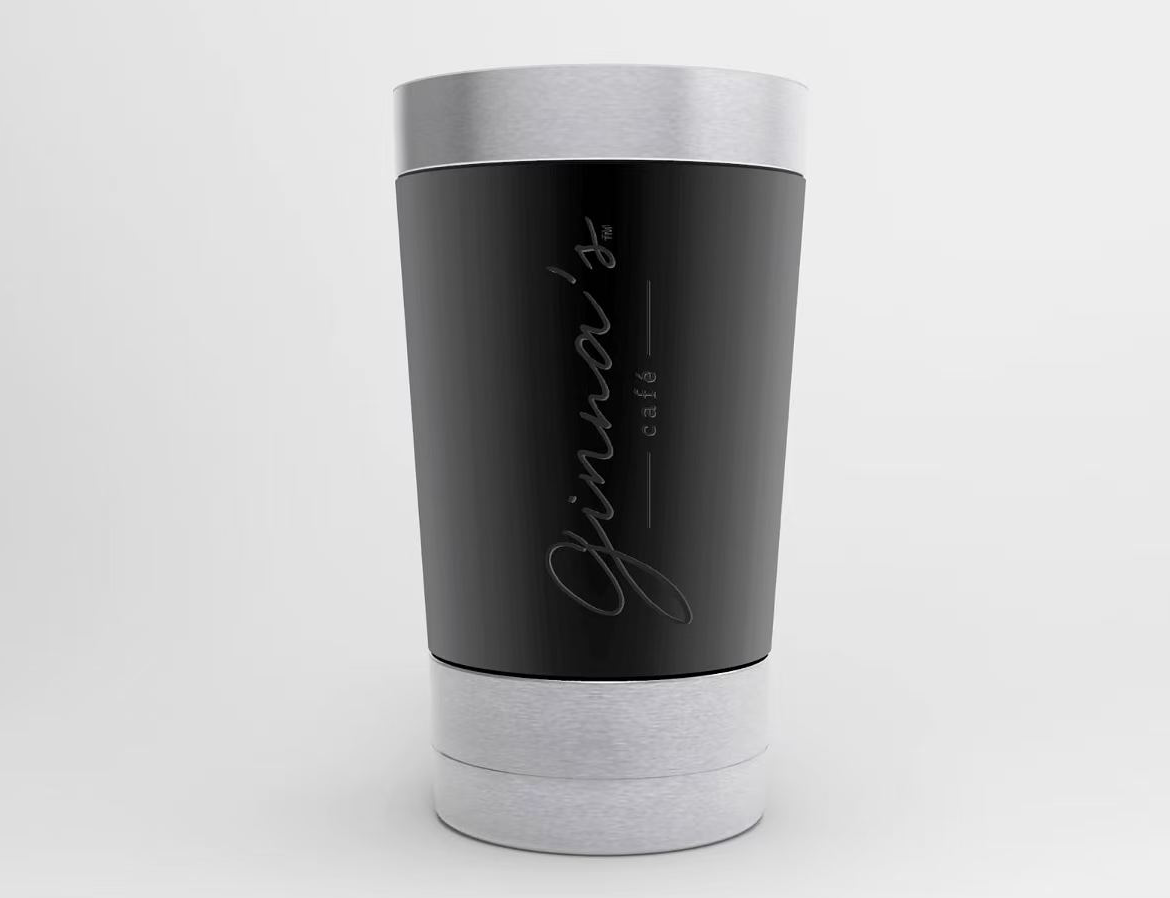
This is an important part of custom drinkware development. A concept may look simple from the outside, but small changes in height, taper, rim width, base proportion, or logo position can significantly affect the appearance and feel of the finished product.
Making these decisions digitally is usually more efficient than discovering every issue after tooling or production has started.
First Physical Sample
Once the design direction was sufficiently stable, the first physical sample was produced.
The goal of the first sample was not to create a perfect finished product. It was to answer practical questions that a drawing or rendering cannot fully answer.
Topnovo checked:
- Does the mug feel balanced in the hand?
- Does the body shape look right at full scale?
- Is the rim comfortable?
- Is the base stable?
- Does the lid fit and function correctly?
- Does the product feel like the intended coffee mug rather than just a metal version of the original plastic cup?
- Can the structure be manufactured consistently?
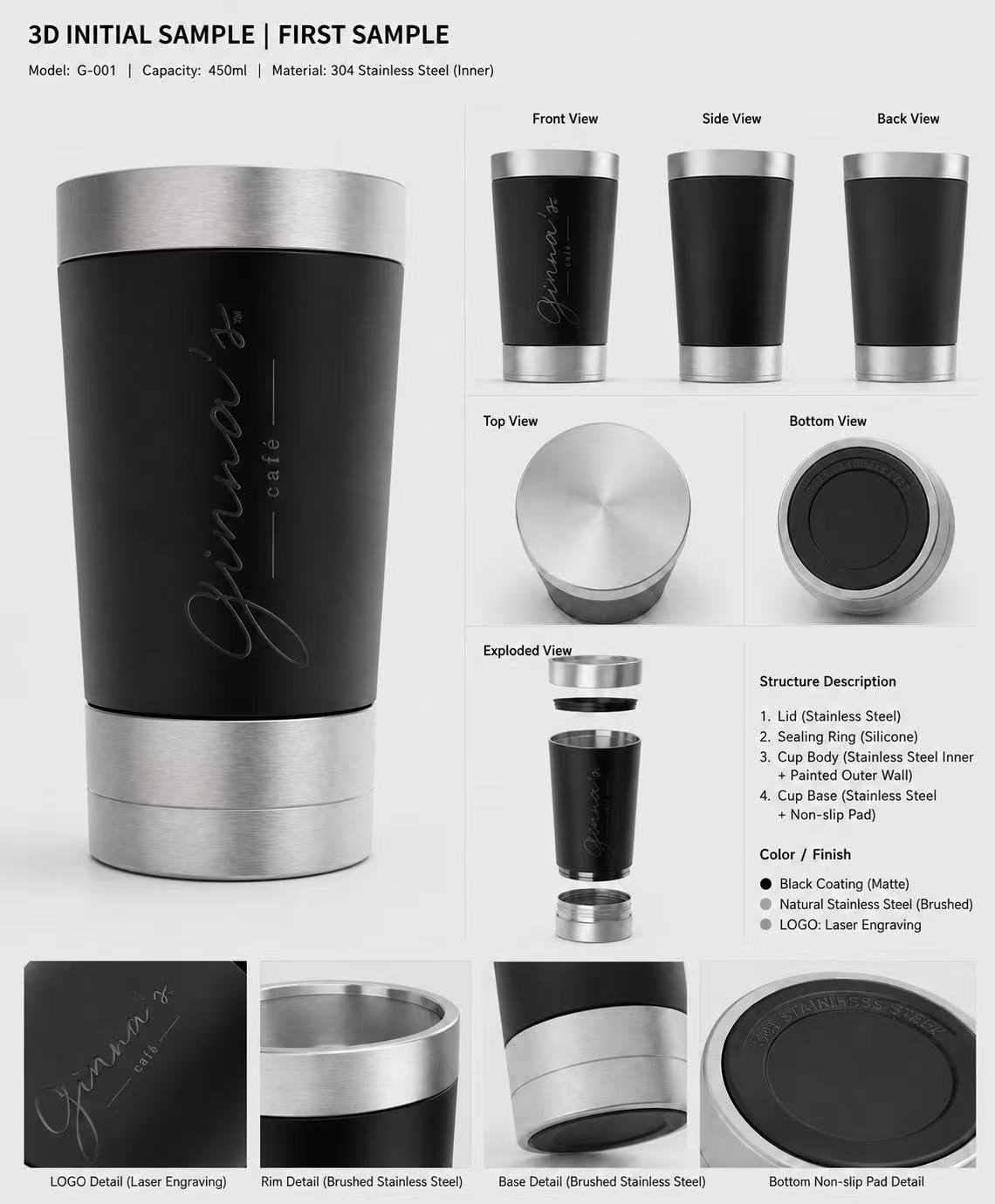
This is why physical sampling remains critical even when the 3D design looks complete. If you are developing a new drinkware product, you can also review Topnovo’s sample request process before moving into bulk production.
Second Sample and Finish Confirmation
The project went through two sample rounds.
After reviewing the first physical sample, the team continued refining the product and prepared the second sample for further confirmation.
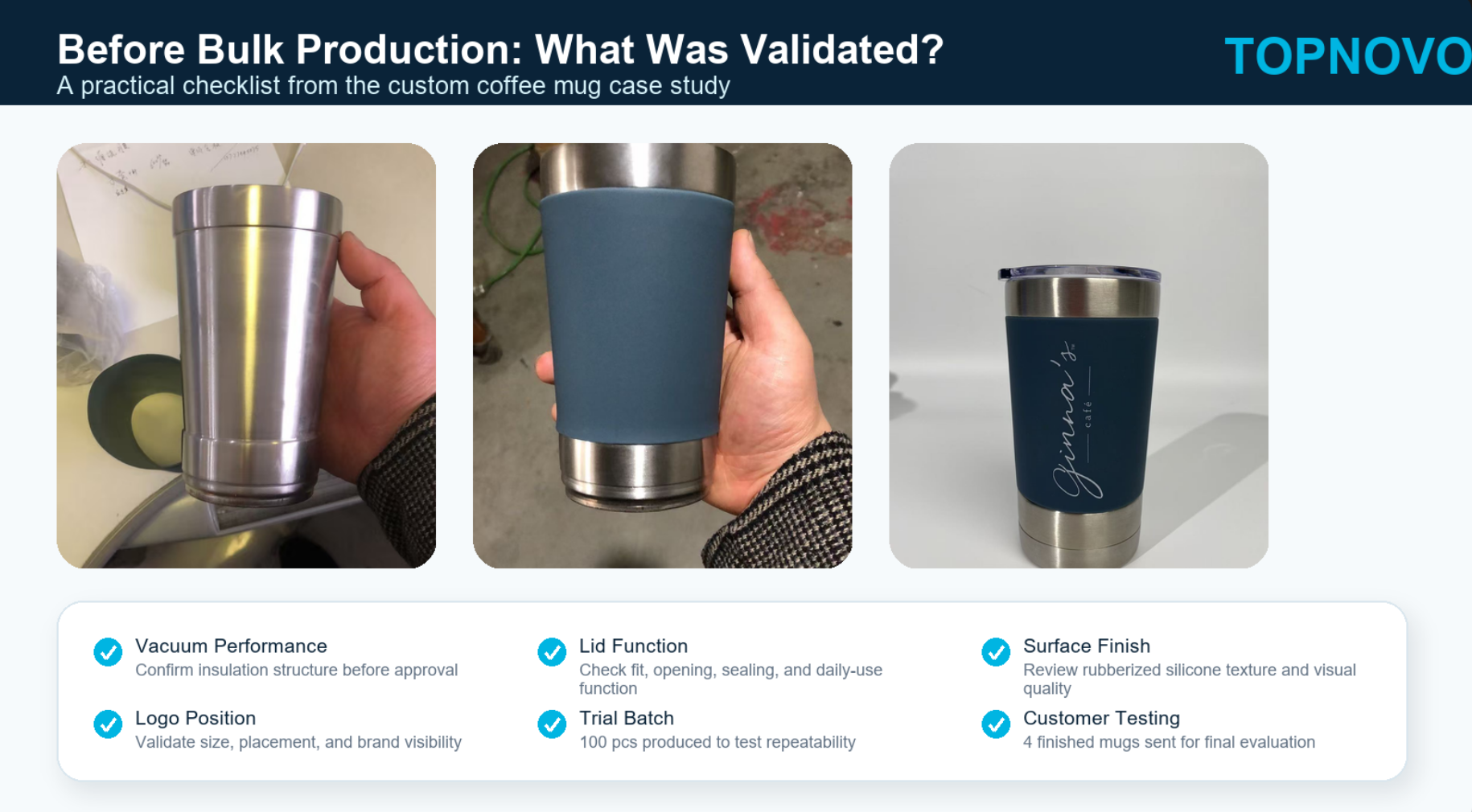
For the surface, the project selected a rubberized silicone finish. The purpose was to give the mug a softer, more distinctive hand feel and create a different visual and tactile experience from a standard stainless steel surface.
Image: Stainless steel trial sample used to review the mug body structure, rim, and base before final finish approval.
For the development sample, screen printing was used for the logo. Screen printing was selected because it was a more cost-efficient decoration method for the sampling stage while still allowing the customer to evaluate logo size, position, and overall appearance.
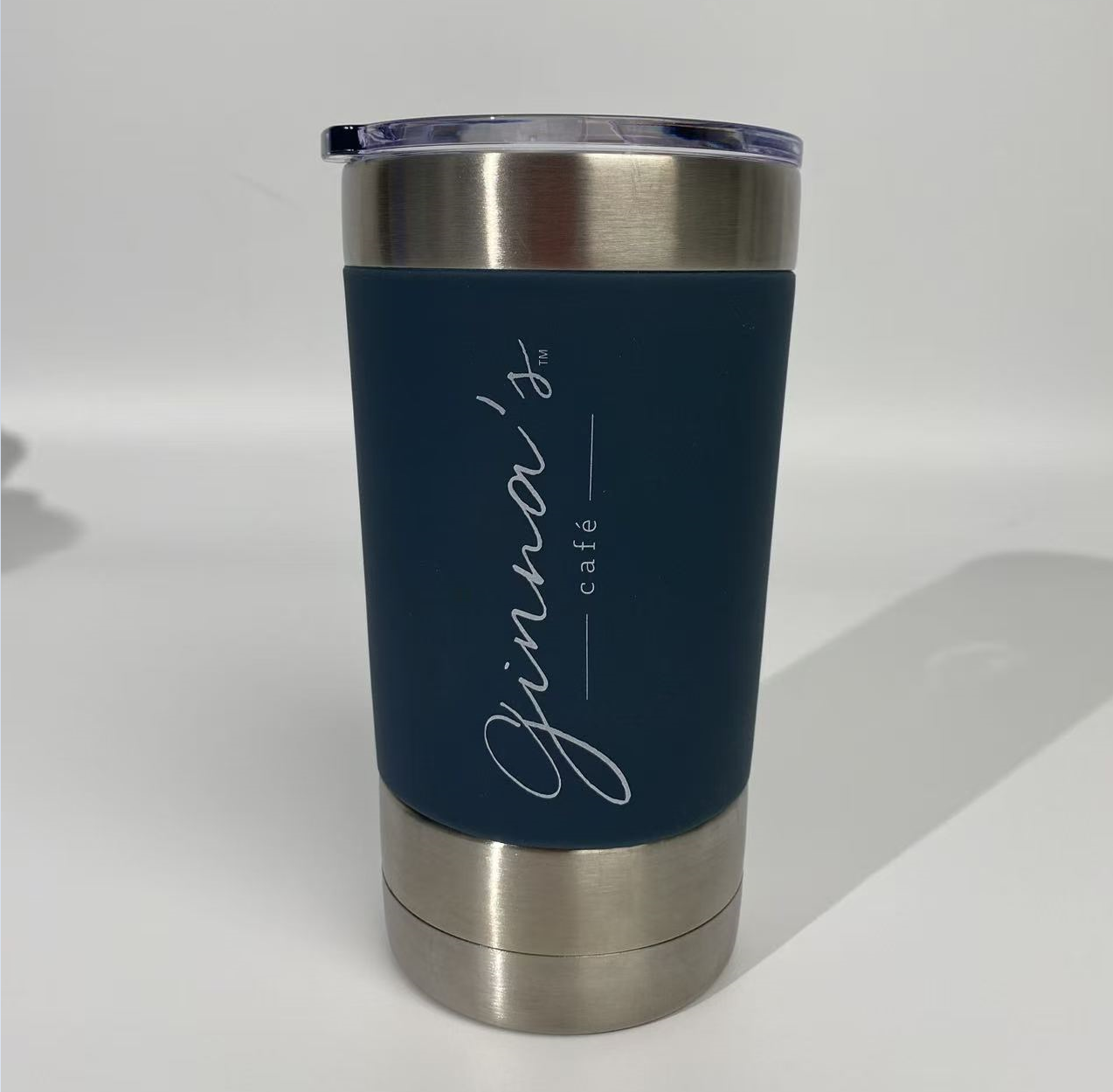
For mass production, the final logo method can still be reviewed according to appearance, durability, quantity, and project budget. If you are comparing decoration methods, this guide to custom logo water bottles explains common options such as screen printing, digital printing, laser engraving, heat transfer printing, and water transfer printing.
Vacuum and Lid Testing
A custom product should not move forward based only on appearance.
Before approving the product direction, Topnovo also tested two functions that directly affect real use: vacuum performance and lid performance.
The mug passed the internal vacuum test, confirming that the double-wall vacuum structure was functioning correctly. The lid also passed the required functional check.
For B2B buyers, this stage matters because a product can look excellent in a rendering and still fail commercially if insulation, lid fit, or daily-use function is unreliable.
Topnovo’s quality control process covers key checks such as material review, insulation testing, leak testing, coating checks, logo inspection, packaging review, and final inspection before shipment.
From Samples to a 100-Piece Trial Batch
After the two sample rounds and final design review, the project did not immediately move into a large production order.
Instead, the next step was a 100-piece small trial batch.
The purpose of this batch was to check whether the approved product could be reproduced consistently beyond one or two development samples.
The trial batch helped validate:
- Product consistency
- Stainless steel body production
- Vacuum performance
- Lid fit
- Surface finish
- Logo application
- Assembly
- General production feasibility
This step creates an important bridge between:
“We made a good sample.”
and
“We can manufacture this product repeatedly.”
If your project has a launch deadline, this stage should be planned early. You can also read Topnovo’s guide on custom water bottle lead time to understand how sampling, approval, production, QC, packaging, and shipping affect the full timeline.
Customer Testing
From the 100-piece trial batch, 4 finished mugs were sent to the customer for testing and evaluation.
This allowed the customer to review the actual product rather than relying only on photos, drawings, or factory feedback.
The customer could evaluate:
- Appearance
- Hand feel
- Capacity
- Lid function
- Surface finish
- Logo result
- Overall product experience
Customer-side testing is especially valuable for newly developed products because the buyer may evaluate the product from a different perspective than the engineering or production team.
Final Result
The project successfully moved from an existing plastic coffee-cup reference to a manufacturable stainless steel product.
Final project result:
- 16oz / 450ml double-wall vacuum coffee mug
- 304 stainless steel inner and outer walls
- Rubberized silicone finish
- Screen-printed development logo
- 5-6 design revisions
- 2 physical sample rounds
- Vacuum test passed
- Lid test passed
- 100-piece trial production completed
- 4 finished units sent for customer testing
The approved development sample was reached in approximately 35 days.
More importantly, the project did not stop at a rendering or a one-off prototype. It continued into small-batch production so both Topnovo and the customer could evaluate whether the design could be manufactured consistently.
What Changed from the Original Idea?
| Original Idea | Developed Product |
|---|---|
| Plastic coffee cup | Double-wall stainless steel mug |
| Basic reusable concept | Vacuum-insulated structure |
| Existing reference shape | Redesigned proportions for stainless steel production |
| Undefined capacity | 16oz / 450ml |
| Standard surface | Rubberized silicone finish |
| Concept branding | Screen-printed sample logo |
| Visual idea | Tested physical product |
| Single reference | 100-piece trial batch |
This is the difference between copying an appearance and developing a product.
What Buyers Can Learn from This Project
Start with the idea, not necessarily a finished drawing
A sketch, reference product, image, or rough concept can be enough to begin development. The important part is turning that idea into clear specifications before production.
Expect design revisions
This project went through 5-6 design revisions. That is not wasted time. It is usually less expensive to improve dimensions, proportions, and details during design development than after molds and mass production have started.
Choose capacity based on the market
Topnovo recommended 16oz / 450ml based on coffee drinkware usage and commercial positioning. Capacity affects customer preference, product weight, packaging, cost, and retail value.
A sample is not the same as production validation
Two successful samples show that a product can be made. A 100-piece trial batch provides much more information about whether it can be made consistently.
Test function before focusing only on appearance
Coating and logo appearance matter, but vacuum insulation and lid performance directly affect user experience. That is why this project included both vacuum and lid testing before moving forward.
Confirm food-contact requirements early
For drinkware sold in the U.S. or EU, buyers should confirm food-contact material requirements early. The U.S. FDA explains how it regulates food packaging and food contact substances, and the European Commission provides guidance on food contact materials. For buyers that need structured quality systems, ISO 9001 is also a useful reference for quality management expectations.
How Topnovo Supported the Project
Topnovo’s role went beyond manufacturing the final mug.
Our team supported the customer through:
- Concept review
- Product direction recommendation
- 2D drawings
- 3D structure development
- Visual mockups
- 5-6 design revision rounds
- Material and capacity decision support
- Two physical sample rounds
- Surface and logo review
- Vacuum and lid testing
- 100-piece trial batch
- Customer testing support
As a stainless steel coffee mug manufacturer and custom drinkware development partner, Topnovo supports brands, wholesalers, retailers and private-label companies from concept development through sampling and production.
Our goal is simple: better drinkware, easier business.
Case Study Facts
Topnovo transformed an existing plastic coffee-cup concept into a 16oz / 450ml double-wall 304 stainless steel custom coffee mug through 5-6 design revisions and two sample rounds. The approved sample was developed in approximately 35 days, followed by a 100-piece trial batch. Vacuum and lid tests passed, and 4 finished units were sent to the customer for further testing.
For brands evaluating custom drinkware manufacturers, this is the type of process that helps reduce the gap between a product idea and repeatable production.
FAQ
Can Topnovo develop a custom coffee mug from only a reference photo?
Yes. A reference photo, existing sample, sketch, or rough idea can be enough to start. Topnovo will help review structure, capacity, material, surface finish, logo method, and production feasibility before sampling.
How long does it take to develop a custom coffee mug?
Simple logo customization can be faster, but a new structure or special finish usually takes longer. In this case, the approved sample stage took approximately 35 days, followed by a 100-piece trial batch.
Why was 304 stainless steel used for this coffee mug?
304 stainless steel is commonly used for food-contact drinkware because it offers good durability, corrosion resistance, and suitability for daily-use mugs and tumblers.
Is a trial batch necessary before mass production?
For a new custom product, a small trial batch is highly recommended. It helps verify whether the approved sample can be produced consistently before larger production begins.
What logo method is best for a custom coffee mug?
It depends on the surface finish, budget, quantity, and brand effect. Screen printing is cost-effective for many bulk projects, while laser engraving can create a more permanent premium look.
Have a Custom Coffee Mug Idea?
You do not need to start with a finished engineering drawing.
If you have a reference product, sketch, image, or rough concept, Topnovo can help evaluate:
- Product structure
- Material
- Capacity
- Lid options
- Surface finish
- Logo method
- Packaging
- Sampling
- Testing
- Trial production
- Mass-production feasibility
From idea to production, the goal is not simply to make a sample. The goal is to develop a product that can be manufactured consistently and sold with confidence.