
| Project overview | Details |
|---|---|
| Customer | An established Amazon drinkware seller |
| Product | Custom stainless steel tumbler |
| Cooperation period | Approximately 18 months |
| TOPNOVO’s role | Manufacturing, quality control and repeat-order improvement |
| Customer identity | Withheld for confidentiality |
A successful Amazon drinkware product is rarely supported by one good sample or one production run.
After a product enters the market, consumer feedback reveals how it performs in everyday use. Repeat production also shows whether the approved quality standard can be maintained from one order to the next.
For approximately 18 months, TOPNOVO worked with an Amazon drinkware customer on the continuing production and improvement of a custom stainless steel tumbler.
Our role extended beyond manufacturing according to purchase orders. We reviewed publicly available market feedback, compared relevant observations with factory records and applied agreed quality-control actions to later production batches.
The customer continued placing repeat orders as the product developed in the market.
The customer’s name, brand, ASIN, sales figures, order quantities and proprietary product specifications are not disclosed in this case study.
The Challenge: Factory Approval Is Only the Beginning
A tumbler can pass sample approval and factory inspection but still face new challenges after entering the market.
Consumers use drinkware in different conditions. Their feedback may reveal patterns that are difficult to identify during a limited product-development cycle.
These patterns can involve:
- Lid operation and sealing
- Silicone-gasket installation
- Insulation consistency
- Coating appearance and durability
- Handle and accessory assembly
- Logo and color consistency
- Packaging protection
- Variation between production batches
For an Amazon seller, a repeated product issue can have consequences beyond an individual replacement or return. It may affect customer satisfaction, reviews and the long-term performance of the listing.
TOPNOVO therefore treated shipment as one stage of the project—not the end of the manufacturing relationship.
Our Approach: Connect Market Feedback With Factory Evidence
Throughout the cooperation, our team paid attention to how the product was received in the market.
We reviewed available feedback to understand:
- Which product features consumers appreciated
- Whether similar concerns appeared repeatedly
- Whether an issue could relate to manufacturing or assembly
- Which areas deserved additional attention in the next production run
However, not every negative review proves that a factory defect exists.
Incorrect use, transportation damage, individual expectations and isolated incidents can also affect the consumer experience. Acting on one comment without investigation could lead to unnecessary product changes.
We therefore looked for patterns and compared the feedback with available manufacturing evidence, including:
- Approved product specifications
- Production records
- Inspection results
- Retained samples
- Customer reports
- Findings from subsequent orders
This helped the team distinguish isolated feedback from a pattern that required further investigation.
Confidentiality note: Customer communications have been paraphrased. Names, product identifiers and commercially sensitive information have been removed.
From Market Feedback Back to the Factory Floor
Monitoring consumer feedback creates value only when relevant findings lead to controlled factory action.
When a recurring concern or possible improvement opportunity was identified, it was returned to the production and quality-control teams for review.
The process followed four basic questions:
- What did consumers report?
- Does the feedback show a repeated pattern?
- Can the factory reproduce or explain the observation?
- What action should be added to the next production run?
The team examined the approved specification, available samples and production records before recommending changes.
Examples of the Improvement Process
The table below summarizes the types of review and production response used during the project. Customer-specific dimensions, tolerances, test parameters and product details have been withheld.
| Market or production signal | Factory review | Production response |
|---|---|---|
| Feedback related to lid use | Reviewed the lid, gasket, assembly method and retained samples | Added focused attention to gasket placement, lid operation and applicable leakage checks |
| Need for greater repeat-order consistency | Compared the approved sample with production and inspection records | Reinforced specification and approval-reference checks before later production |
| Appearance consistency required attention | Reviewed coating, color and surface-inspection results | Strengthened checks for color consistency, visible defects and finish quality |
| Packaging condition required review | Examined the individual pack, insert and carton arrangement | Increased verification of product protection and packing accuracy |
| Multiple accessories increased assembly complexity | Reviewed lid, straw, handle and component combinations | Added component and packing checks for the agreed accessory set |
These were not uncontrolled design changes. Any product or process adjustment needed to be evaluated against the approved specification and agreed with the customer where appropriate.
Lid and Sealing Performance

The lid system can strongly influence how consumers experience a tumbler.
The body, lid, gasket and assembly method must work together. A correct component can still perform inconsistently if the gasket is not installed correctly or the lid is assembled differently between units.
Where additional attention was required, the team reviewed:
- Lid and cup-body fit
- Silicone-gasket placement
- Opening and closing operation
- Relevant leakage-test procedures
- Assembly consistency between samples
The objective was not to describe the product as “100% leakproof” without evidence. It was to check the product against the agreed functional requirement.
Vacuum-Insulation Consistency
The performance of an approved insulated sample must be repeatable during bulk and repeat production.
Vacuum-insulation quality cannot be judged by appearance alone. It requires an appropriate production and testing process.
For this project, vacuum and insulation checks remained part of continuing production control rather than being treated as a one-time development test.
The applicable test conditions and acceptance criteria remained part of the confidential product specification.
Surface and Coating Quality
Product appearance is commercially important for online sales because customers compare the item they receive with the photographs displayed on the listing.
The inspection process considered:
- Color consistency
- Visible coating defects
- Surface contamination
- Scratches and dents
- Logo appearance
- Consistency with the approved reference
- Differences between repeat orders
A product may remain functionally usable while still disappointing a consumer because its appearance does not match expectations. Appearance requirements should therefore be defined and inspected—not treated as subjective preferences after production.
Component and Accessory Assembly
A custom tumbler may contain a lid, handle, straw, gasket and additional accessories.
Even when all the individual components are correct, inconsistent assembly or packing can create a poor customer experience.
The team reviewed:
- Component fit
- Lid and handle operation
- Correct gasket installation
- Accessory quantities
- Product and accessory combinations
- Packing accuracy
For multi-component products, the bill of materials and approved sample should remain consistent across repeat orders.
Packaging Protection
A product can leave the production line in good condition and still reach the customer with scratches, dents or damaged packaging.
Packaging checks therefore considered:
- Protection of coated surfaces
- Individual packaging
- Insert structure
- Product movement inside the box
- Carton arrangement
- Accessories and instructions
- Labels and carton marks
The objective was to reduce preventable damage and help products arrive in saleable condition.
Buyers planning retail or e-commerce packaging can review TOPNOVO’s custom water bottle packaging guide.
Quality Control Became a Repeat-Order Process
Some buyers think quality control occurs only during final inspection.
For a product manufactured through continuing orders, final inspection alone is insufficient. The approved requirements and lessons from earlier orders must be carried into the next production cycle.
Quality attention for this project included several stages.
Incoming materials and components
Materials and purchased components were reviewed against the agreed requirements before entering the relevant production stages.
In-process inspection
Production-stage checks helped identify variations before the entire order was completed.
Lid-function and leakage checks
Lids, gaskets and assembled products were checked according to the applicable requirements.
Vacuum and insulation checks
Insulated units were reviewed using the factory’s relevant vacuum and insulation-control process.
Appearance and coating inspection
Inspectors examined surface finish, visible defects, coating consistency and logo appearance.
Packaging inspection
Product quantities, accessories, individual boxes, labels and master-carton information were checked before shipment.
TOPNOVO’s broader water bottle quality-control process covers materials, vacuum performance, leakage, coatings, logos, assembly and packaging.
The 18-Month Continuous Improvement Loop
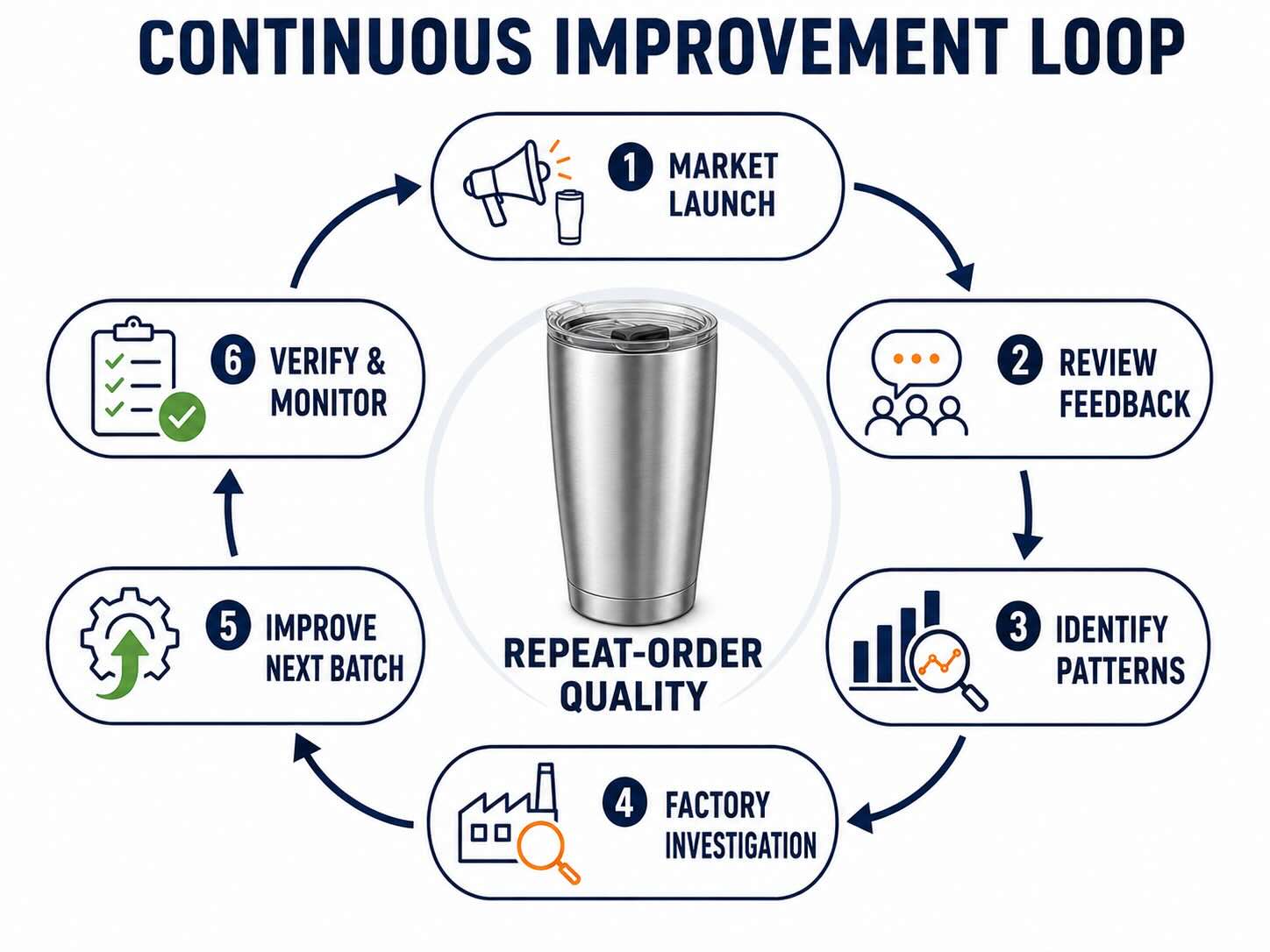
There was no single dramatic change that transformed the project.
Progress was incremental.
Each repeat order provided additional manufacturing information. Market feedback highlighted areas worth investigating. QC records helped the team evaluate consistency, and the next production run created an opportunity to apply and verify agreed actions.
The working cycle followed this pattern:
Market launch
↓
Review consumer and customer feedback
↓
Identify repeated patterns
↓
Compare feedback with samples and production records
↓
Agree on production or inspection actions
↓
Apply the actions to the next batch
↓
Verify and monitor again
This cycle continued for approximately 18 months.
The important achievement was not that every individual production unit could be described as perfect. It was that the project had a structured process for investigating feedback and improving repeat-order control.
How a Feedback Investigation Works
Consider a simplified example involving several comments about an inconsistent lid experience.
A responsible manufacturer should not immediately assume that the product design is defective. The first step is to investigate.
The team can review:
- Whether the comments describe the same symptom
- Whether the affected products came from the same production period
- Whether the approved lid or gasket specification changed
- Whether assembly records show unusual variation
- Whether retained samples reproduce the reported behavior
- Whether transportation, use, assembly or components could be involved
- Whether an additional inspection checkpoint is required
The resulting action might involve reinforcing the assembly method, adding a gasket-placement check or clarifying the functional test.
The appropriate action must be based on evidence—not on one isolated review.
The Result: Greater Control Across Repeat Orders
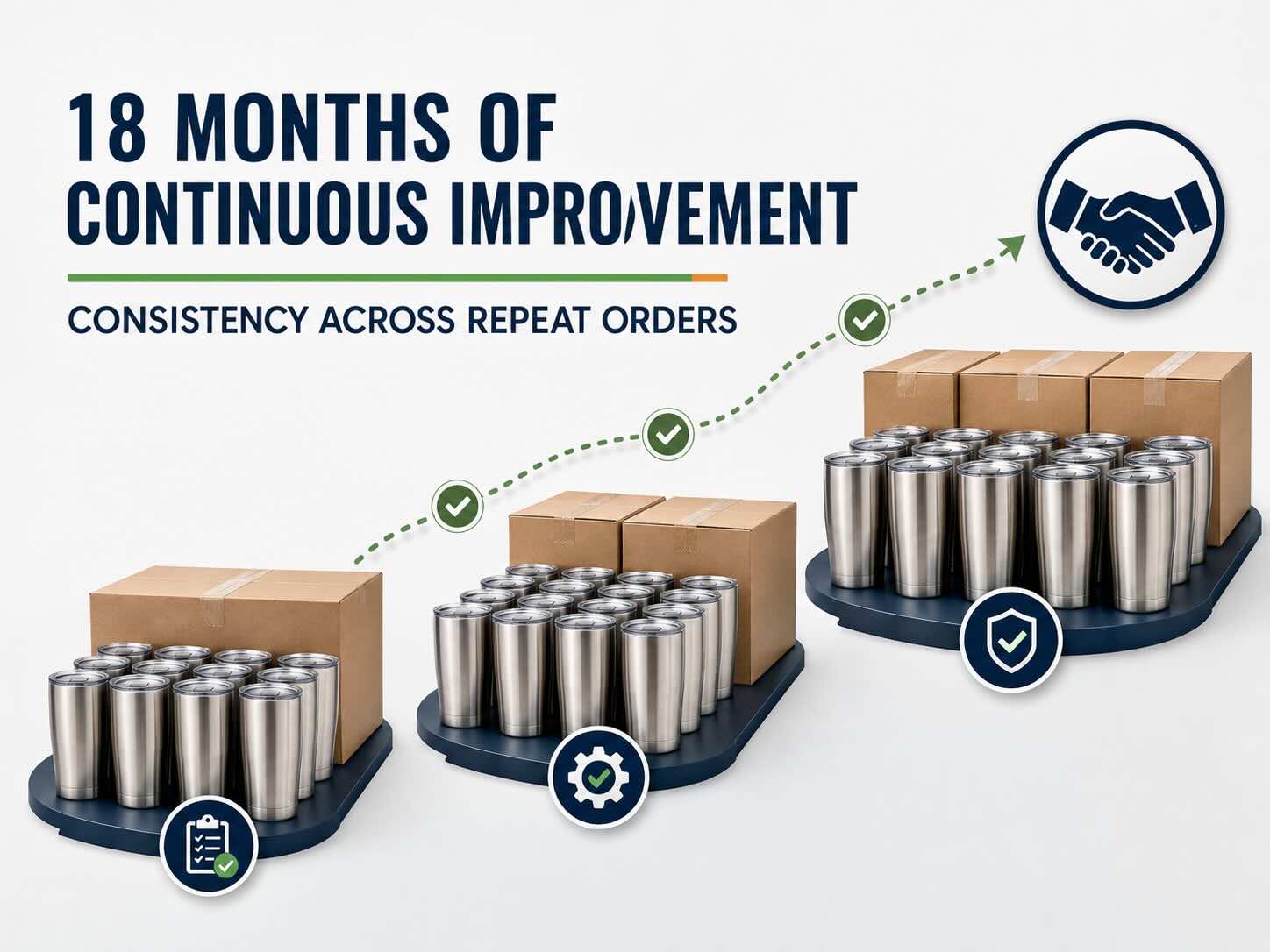
During the approximately 18-month cooperation period, the customer continued placing repeat orders while the product developed in the market.
This repeat business required more than recreating the original sample. It required the factory to maintain the approved product requirements and carry earlier findings into later production.
As a product grows, the manufacturing system may need to manage:
- More production batches
- Additional material and component deliveries
- More inspection records
- Larger inventory exposure
- Greater consequences if an issue is repeated
TOPNOVO’s objective was to help ensure that repeat production remained controlled as the project continued.
This case study does not claim that manufacturing alone caused the product’s commercial growth. Amazon performance can also depend on product positioning, pricing, advertising, inventory, listing content, competition and customer service.
Our responsibility was the part we could control: manufacturing execution, quality attention and repeat-order improvement.
The Customer Benefit: Reduced Operational Pressure
Amazon sellers already manage:
- Inventory
- Advertising
- Pricing
- Competitors
- Cash flow
- Listing performance
- New product development
- Product launches
They should not need to remind the factory repeatedly to check the same lid detail, match the approved color or prevent a known issue from recurring.
Once a requirement or corrective action is agreed, it should become part of the product record and relevant quality-control process.
A responsive supplier manufactures the current purchase order. A long-term manufacturing partner also learns from previous production and applies that knowledge to future orders.
What Drinkware Buyers Can Learn From This Case
Do not evaluate a custom tumbler manufacturer only by the first quotation or first approved sample.
Before starting a long-term program, ask:
- Does the factory retain approved specifications and samples?
- Are product changes recorded before repeat production?
- Can the supplier investigate repeated consumer complaints?
- Are production and inspection records available?
- Does the next order benefit from what was learned previously?
- Will the tenth order receive the same attention as the first?
- Can the quality system support larger repeat orders?
- Who is responsible for approving corrective actions?
A successful sample is important, but it represents only a limited number of units. The greater test is whether the manufacturer can reproduce the approved result across bulk production and future orders.
Buyers can also request a custom drinkware sample and define the approval and inspection requirements before placing a bulk order.
Building Long-Term Drinkware Products With TOPNOVO
TOPNOVO supports drinkware brands, Amazon sellers, retailers, importers and distributors through product development, customization, sampling, mass production and ongoing quality control.
Our goal is not simply to manufacture the next order. We aim to help customers build drinkware products that can be manufactured consistently and improved responsibly over time.
If you are developing a stainless steel tumbler or water bottle, send us:
- Your product or reference image
- Estimated order quantity
- Target market
- Color and logo requirements
- Lid and accessory requirements
- Packaging requirements
- Quality and testing expectations
- Required delivery date
Learn more about how to work with TOPNOVO or contact our team to discuss your project.
Better Drinkware. Easier Business.
Confidentiality statement: Customer identity, product identifiers, order quantities, commercial performance and proprietary specifications have been withheld or generalized. This case study describes TOPNOVO’s working process without disclosing the customer’s confidential information.