
Quick Answer: What Should a Custom Drinkware RFQ Include?
An accurate custom drinkware RFQ should define the product, customization, order quantity, packaging, quality requirements and delivery terms.
Provide these 12 inputs:
- Product type and reference model
- Capacity and critical dimensions
- Materials and insulation structure
- Lid, straw, handle and accessories
- Quantity by SKU and color
- Color and surface finish
- Logo method, size and position
- Individual and master-carton packaging
- Target market and compliance requirements
- Sample and quality-control requirements
- Destination postal code and Incoterm
- Required delivery date
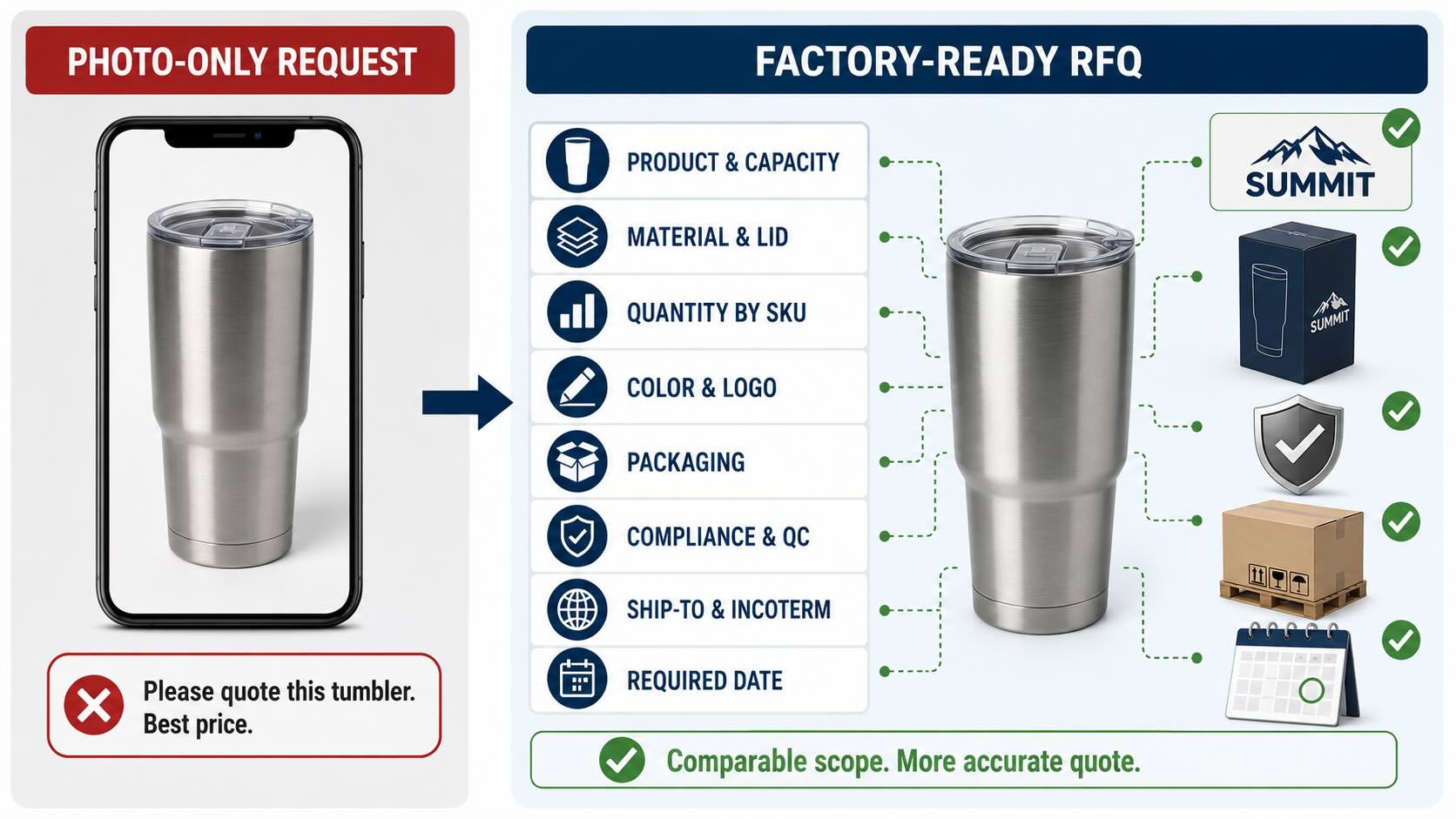
A product photo can start the discussion, but it cannot produce a fully accurate and comparable factory quotation. It does not confirm materials, dimensions, included accessories, packaging, testing requirements or delivery terms.
If a specification is undecided, write “open for supplier recommendation.” This prevents different factories from making unrecorded assumptions.
Download the Free Custom Drinkware RFQ Template
Editable Excel format with RFQ fields, SKU planning, packaging data and supplier comparison.
Download the Excel RFQ Template
Initial Inquiry vs Factory-Ready RFQ
Not every inquiry needs a complete technical specification. The required detail depends on the stage of your project.
| RFQ level | Information provided | Expected result |
|---|---|---|
| Initial inquiry | Reference photo, product type, approximate quantity and destination | Product availability and preliminary discussion |
| Budgetary RFQ | Basic specification, quantity tiers, logo and packaging type | Estimated price range for planning |
| Factory-ready RFQ | Final materials, components, artwork, packaging, QC and delivery terms | Comparable quotation for sampling and production |
An initial inquiry can produce an estimated price. A factory-ready RFQ is required when buyers need to compare suppliers fairly or plan a production order.
Why Is a Product Photo Not Enough?
Two tumblers can look almost identical but have different:
- Inner- and outer-wall steel grades
- Steel thicknesses and finished weights
- Vacuum-insulation structures
- Lid materials and sealing systems
- Coatings and decoration processes
- Accessories and replacement parts
- Retail packaging
- Testing requirements
These differences affect unit price, MOQ, tooling, sample cost, lead time and freight.
A weak request might say:
Please quote this 40oz tumbler. Best price.
A more useful request says:
Please quote a 40oz double-wall vacuum tumbler based on the attached reference. Quote a SUS304 inner wall, supplier-standard outer wall, screw-on handle, clear straw lid, two reusable straws, matte-black powder coating, one-side laser logo and individual white-box packaging. Quantity: 1,000, 3,000 and 5,000 pieces. Please provide FOB Ningbo and DDP Dallas 75201 prices separately.
The second version gives the manufacturer a consistent basis for pricing.
The 12-Point Custom Drinkware RFQ Checklist

Identify the Product and Intended Use
Specify whether you need a:
- Stainless steel tumbler
- Insulated water bottle
- Travel mug
- Coffee mug
- Sports or kids’ bottle
- Plastic drinkware product
- Drinkware gift set
Attach a model number, product URL, drawing, sample or reference image. Explain whether the reference shows the exact product, a preferred shape, a lid concept or only a visual direction.
Also state the target user, sales country and sales channel. An Amazon product may require protective packaging and fulfillment labels. A corporate gift project may prioritize logo visibility and a fixed delivery date.
If you have an original concept instead of a finalized model, TOPNOVO’s custom drinkware product development service can help define the structure, materials, dimensions, prototype and sampling route before production.
State the Capacity and Critical Dimensions
State capacity in both US fluid ounces and milliliters.
| Nominal capacity | Approximate metric capacity |
|---|---|
| 12 US fl oz | 355 mL |
| 20 US fl oz | 591 mL |
| 30 US fl oz | 887 mL |
| 40 US fl oz | 1,183 mL |
These are mathematical conversions. Usable capacity can differ from brimful capacity, so ask how the supplier measures it.
Where relevant, provide:
- Overall height
- Maximum body diameter
- Base diameter
- Mouth diameter
- Handle clearance
- Finished product weight
- Cup-holder requirement
- Maximum retail-package size
If dimensions are still undecided, ask the supplier to provide a specification drawing with the quotation.
Define Materials and Insulation
“Food-grade stainless steel” is not a complete specification.
Identify the material for the inner wall, outer wall, lid, straw and sealing ring. Common constructions include:
- SUS304 inner wall with SUS201 outer wall
- SUS304 inner and outer walls
- SUS316 inner wall with SUS304 outer wall
Also state whether the product is:
- Single-wall or double-wall
- Vacuum-insulated or non-vacuum
- Copper-plated inside the vacuum layer
- Intended for hot, cold or acidic beverages
If you are unsure, ask for alternatives:
Please quote SUS201 and SUS304 outer-wall options separately and state the finished product weight for each.
The FDA explains that food-contact compliance depends on the substances, intended use and conditions of use—not a generic “FDA-approved bottle.” See the FDA guidance on food-contact materials.
Specify the Lid and Accessories
Identify:
- Screw-on or press-fit lid
- Straw, flip, slider, chug or spout opening
- Plastic or stainless steel straw
- Fixed or removable handle
- Removable silicone gasket
- Spare straw, gasket or cleaning brush
- Gift accessories
Describe the required function as well as the appearance. Splash resistance and leak resistance are not the same.
If leak resistance is required, define the test conditions, including fill level, liquid temperature, orientation, duration, sample size and acceptance criterion.
Break Down Quantity by SKU
Do not state only the total order quantity when the project has several colors or models.
| SKU | Capacity | Color | Quantity |
|---|---|---|---|
| T20-BLK | 20 oz | Matte black | 2,000 |
| T20-WHT | 20 oz | White | 1,500 |
| T20-BLU | 20 oz | Navy | 1,500 |
Ask whether MOQ applies per:
- Product model
- Capacity
- Color
- Logo design
- Packaging design
- Total order
Request practical price tiers such as 1,000, 3,000 and 5,000 pieces. Do not assume several small color quantities can automatically be combined to meet one MOQ.
Define Color and Surface Finish
Provide a Pantone reference or physical color sample where possible. Phone and computer screens are not reliable production color standards.
Identify the required finish:
- Powder coating
- Spray painting
- Brushed or polished steel
- Plating
- Sublimation coating
- Gradient or specialty finish
Also specify matte, glossy or textured appearance and any acceptable color tolerance.
Provide Complete Logo Information
Include:
- Vector artwork in AI, EPS, SVG or editable PDF
- Logo width and height
- Decoration position
- Number of colors
- One-side, two-side or wraparound application
- Preferred decoration method
- Durability requirement
Common methods include laser engraving, screen printing and UV printing. Ask the supplier to list any plate, fixture, setup and tooling charges separately.
Specify Packaging
State the required individual packaging:
- White or kraft box
- Printed color box
- Gift or window box
- Paper, pulp or foam insert
- Instruction sheet
- Barcode or FBA label
- Country-of-origin marking
For the master carton, request:
- Units per carton
- Carton dimensions
- Net and gross weight
- Total carton quantity
- Estimated shipment volume
- Carton marks and pallet requirements
Packaging affects both protection and freight. Compare suppliers only after confirming that they are quoting the same packaging configuration.
Identify Market and Compliance Requirements
Tell the manufacturer where and how the product will be sold.
Confirm:
- Destination country
- Intended user
- Retail, promotional or e-commerce channel
- Intended beverage and temperature
- Required compliance documents
- Whether new testing is required
- Who pays for and owns the test report
For EU sales, food-contact materials generally need to meet Regulation (EC) No 1935/2004 and applicable material-specific requirements. See the European Commission food-contact materials guidance.
Do not ask only whether the factory “has FDA, LFGB or REACH.” Verify that the evidence applies to the final model, materials, components and intended market.
Define Sample Approval and QC
State whether you require a stock sample, customized sample, pre-production sample or packaging sample.
Ask the supplier to quote:
- Sample cost
- Customization cost
- Courier cost
- Sample preparation time
- Revision cost where applicable
Create a written approval record covering the model, materials, dimensions, lid, color, logo, packaging and functional requirements.
Your quality plan may include leakage, insulation, lid operation, coating adhesion, logo position, color consistency and packaging checks.
Provide Destination and Incoterm
“Ship to the USA” is not enough for a reliable delivery quotation.
Provide the country, city, postal code, address type and delivery restrictions. State the Incoterm and named place clearly:
FOB Ningbo, Incoterms® 2020DDP Dallas, Texas 75201, Incoterms® 2020
FOB and DDP are Incoterms® rules, not shipping methods. A shipment can move by sea, air, rail or courier under different commercial arrangements.
Do not directly compare an FOB price with a DDP price because they include different costs and responsibilities. Review the ICC guidance on Incoterms® rules when selecting the appropriate term.
State the Required Delivery Date
Explain whether your deadline means:
- Factory completion
- Port departure
- Port arrival
- Warehouse delivery
- Retail launch or event date
Ask when the quoted production lead time begins. It may start after the deposit, artwork approval, sample approval, packaging approval or final specification confirmation.
Plan backward from the warehouse-delivery date and allow time for sampling, testing, production, inspection, freight booking, customs clearance and final delivery.
What Should a Complete Factory Quote Include?
A factory quote should show more than the unit price.
| Quote field | What the supplier should confirm |
|---|---|
| Product | Model, capacity, materials and accessories |
| Pricing | Unit price by quantity tier |
| MOQ | MOQ basis by model, color, logo or packaging |
| Extra charges | Logo setup, tooling, samples and testing |
| Packaging | Box type, carton quantity, size and weight |
| Delivery | Incoterm® rule, named place and inclusions |
| Timing | Sample time and production lead-time trigger |
| Payment | Deposit, balance and payment method |
| Validity | Quotation expiration date |
| Exclusions | Costs or services not included |
A complete drinkware factory quote should state the exact specification, MOQ basis, additional charges, packaging data, Incoterm, lead time, payment terms, validity and exclusions.
How to Compare Drinkware Quotations
Normalize the quotations before comparing prices.
Suggested evaluation criteria:
| Criterion | Example weight |
|---|---|
| Specification compliance | 25% |
| Quality system and evidence | 20% |
| Total cost transparency | 20% |
| Sample quality | 15% |
| Lead-time reliability | 10% |
| Communication and development support | 10% |
These are example weights, not an industry standard. Adjust them to your project. A promotional order with a fixed event date may assign more weight to delivery. A retail brand may prioritize compliance, consistency and packaging.
A lower unit price is not a saving if it excludes required materials, testing, packaging or delivery services.
Frequently Asked Questions
What information is needed for a custom tumbler quote?
Provide the product reference, capacity, materials, lid, quantity by SKU, finish, logo, packaging, target market, QC requirements, destination, Incoterm and delivery date.
Is a product photo enough?
A photo is enough for an initial discussion but not a final comparable quotation. It does not confirm materials, dimensions, components, logo, packaging or testing requirements.
Does MOQ apply to the total order?
Not always. MOQ may apply per model, capacity, color, logo or packaging design. Ask the supplier to state the MOQ basis in writing.
Should I request FOB or DDP pricing?
Request FOB when you or your forwarder will manage the main transportation and import process. Request DDP when you want delivery quoted to a named destination. Ask what each price includes.
When does production lead time begin?
It depends on the quotation. The lead time may begin after deposit, artwork approval, final-sample approval or final specification confirmation.
Send Your RFQ to TOPNOVO
TOPNOVO supports existing-model customization and OEM drinkware development. Our published capabilities include a 24,000㎡ manufacturing facility, annual capacity exceeding nine million units and 16 full-time quality-control inspectors.
After completing the template, send TOPNOVO:
RFQ file · Product reference · Logo artwork · Target market · Quantity · Required delivery date
Our team can review missing specifications and prepare the appropriate quotation or sample recommendation.
Before submission, you may also review our custom water bottle MOQ guide and custom water bottle production lead-time guide.
For bottle models and manufacturing options, explore TOPNOVO’s custom drinkware manufacturing for stainless steel water bottles.
Send Your RFQ and Start Your Project
Better Drinkware. Easier Business.