
Quick Answer
Stainless steel water bottles do not require one universal certificate. Depending on the destination market, buyers may need a combination of regulatory compliance documents, laboratory test reports, declarations and, in certain cases, product certificates.
Typical requirements include:
- United States: applicable FDA food-contact requirements and BPA-free support for relevant plastic components
- European Union: Regulation (EC) No 1935/2004, food-contact GMP requirements and material-specific rules
- Germany: applicable EU requirements, German LFGB provisions and relevant BfR recommendations
- EU chemical compliance: REACH assessment for relevant substances and components
- California: Proposition 65 exposure assessment
- Children’s products in the US: applicable CPSC requirements, third-party testing and a Children’s Product Certificate where required

The correct compliance package depends on:
Target market + intended user + bottle materials + lid and accessory configuration + conditions of use + buyer requirements
Buyers should confirm that documents cover the actual stainless steel body, lid, straw, silicone seal, coating and printed components—not simply another product made by the same supplier.
Stainless Steel Water Bottle Compliance by Market
| Target market | What buyers should evaluate | Relevant components |
|---|---|---|
| United States | Applicable FDA food-contact requirements; BPA-free support | Steel, plastic lid, straw, silicone seal |
| European Union | EC 1935/2004; EC 2023/2006; material-specific requirements | All food-contact materials |
| Germany | EU requirements; LFGB; relevant BfR recommendations | Bottle, lid, silicone, straw |
| EU chemical compliance | REACH obligations and restricted substances | Coatings, inks, plastics, silicone, metals |
| California | Proposition 65 exposure assessment | Coatings, inks, plastics and metals |
| US children’s market | Applicable CPSC rules; CPC where required | Accessible materials, coatings and components |
| Retail and marketplaces | Legal requirements plus buyer-specific standards | Finished product and packaging |
Requirements can vary by importer, retailer, marketplace and product design. Confirm the target country and final product specification before arranging testing.
Product Compliance Is Not the Same as a Factory Audit
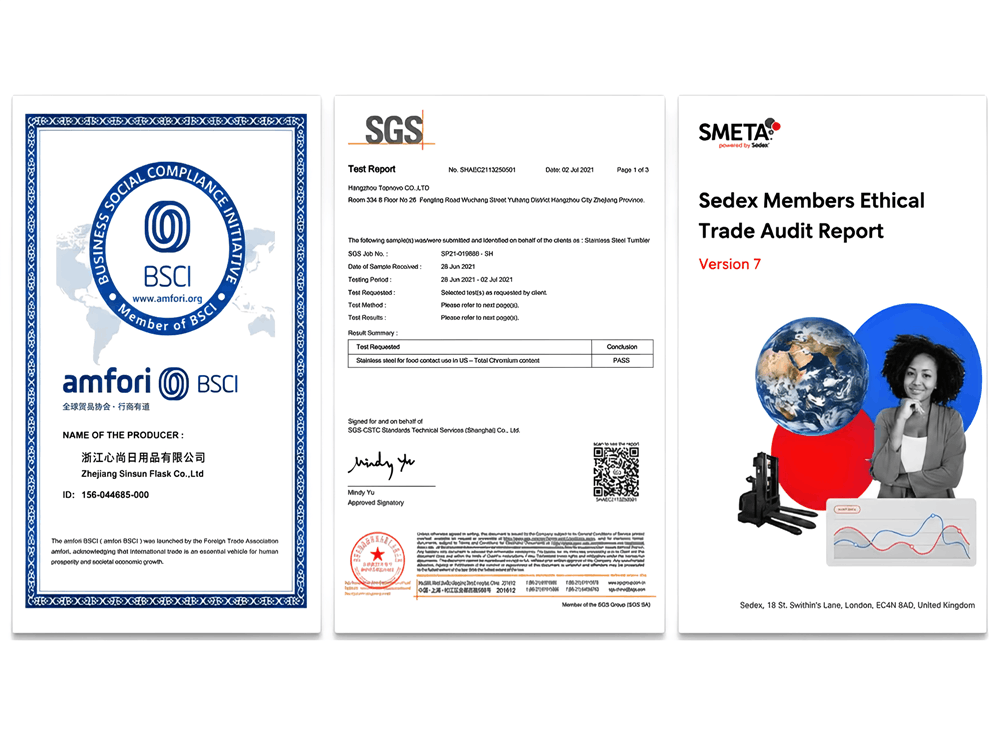
Product documents and factory audits serve different purposes.
| Document type | Examples | What it evaluates |
|---|---|---|
| Food-contact compliance | FDA-related documentation; EU food-contact testing | Materials that may contact beverages |
| Chemical compliance | REACH; Prop 65 assessment | Restricted chemicals or exposure |
| Material claim support | BPA-free test or declaration | Relevant plastic components |
| Children’s product compliance | CPSIA-related testing; CPC | Applicable children’s product rules |
| Quality management | ISO 9001 | Factory management system |
| Social compliance | BSCI; Sedex/SMETA | Labor and ethical practices |
| Product inspection | Pre-shipment inspection report | Bulk product quality and packaging |
An ISO 9001 certificate, BSCI audit or SMETA report can help evaluate a supplier, but it does not replace product-specific compliance testing.
What Does FDA Compliance Mean for Water Bottles?
The phrase “FDA-approved water bottle” can be misleading. For the US market, buyers should determine whether the materials and substances used in the product comply with applicable food-contact requirements under their intended conditions of use.
The FDA explains that the regulatory status of a food-contact material depends on the substances that make up the article, their intended use and applicable authorizations. See the FDA guidance on food-contact material components.
Relevant water bottle components may include:
- Stainless steel food-contact surfaces
- Plastic lids and internal parts
- Plastic straws
- Silicone sealing rings
- Adhesives, coatings or other food-contact materials
What should US buyers request?
Ask the supplier:
- What grades of stainless steel, plastic and silicone are used?
- Which documents support their intended food-contact use?
- Which plastic components are covered by the BPA-free claim?
- Do the documents match the final lid, straw and seal?
- Do the tested conditions reflect hot, cold, acidic or other intended beverages?
A more precise question than “Do you have FDA?” is:
Which food-contact documents apply to the materials and intended use of this finished bottle?
What Are the EU Food-Contact Requirements?
All food-contact materials placed on the EU market must comply with the general safety principles of Regulation (EC) No 1935/2004. They must also be manufactured according to food-contact Good Manufacturing Practice under Regulation (EC) No 2023/2006.
Plastic food-contact components, such as certain lids or straws, may also fall under Regulation (EU) No 10/2011, including applicable composition and migration requirements.
The final assessment may therefore involve:
- Stainless steel body
- Plastic lid and straw
- Silicone sealing ring
- Internal coatings
- Printed or decorated areas where relevant
- Intended beverage type and temperature
- Supporting declarations and test reports
The European Commission provides a current overview of EU food-contact materials legislation.
Do not describe an EU 10/2011 report as covering the entire bottle automatically. Its scope should be checked against the materials and components actually tested.
Is LFGB a Water Bottle Certification?
LFGB is a German legal framework, not one universal product certification.
The term “LFGB test” is commonly used in sourcing, but the applicable test scope depends on the product material, food-contact conditions and final configuration. Testing may consider:
- Plastic lid components
- Silicone seals
- Straws
- Stainless steel food-contact surfaces
- Sensory effects, including unacceptable taste or odor changes
- Other relevant materials
BfR recommendations may also be used when evaluating materials such as silicone or rubber. However, the German Federal Institute for Risk Assessment explains that its recommendations are not binding legal standards; they represent scientific and technical guidance for relevant food-contact materials. See the BfR food-contact material recommendations.
An existing “LFGB report” should not be accepted until the buyer confirms that the sample, materials and components match the product being ordered.
Does REACH Apply to Stainless Steel Water Bottles?
REACH is an EU chemical regulation that may create obligations for substances present in drinkware components.
A review may include:
- Paints and powder coatings
- Color pigments
- Printed inks
- Plastic parts
- Silicone parts
- Adhesives
- Metals and other relevant materials
REACH is not the same as EU food-contact compliance. A product may need to be evaluated under both frameworks.
Candidate List substances of very high concern can trigger communication and other obligations when applicable conditions are met. Buyers can review the ECHA guidance on Candidate List substances in articles.
Instead of asking only “Do you have REACH?”, ask:
Does the REACH documentation cover the materials, colors, coatings and components used in my final product?
What Does California Proposition 65 Require?
California Proposition 65 is an exposure-warning law, not a conventional product certification.
A business may need to assess whether use of the finished bottle could expose consumers to a listed chemical at a level requiring a warning. Relevant areas may include coatings, inks, plastics, silicone and metal components.
A passing report for one color or decoration does not necessarily cover every variation. If California is a target market, review the final materials and artwork before mass production.
The need for testing, an exposure assessment or a warning should be determined with a qualified laboratory or compliance adviser.
Does BPA-Free Apply to Stainless Steel?
BPA-free claims normally relate to relevant plastic components rather than the stainless steel body.
These may include:
- Plastic lids
- Straws
- Flip caps
- Internal plastic parts
- Plastic accessories
Buyers should identify exactly which components are covered. Changing the lid, straw or resin can affect whether existing BPA-free documentation remains applicable.
What About Children’s Water Bottles?
In the United States, a product designed or intended primarily for children aged 12 or younger may be classified as a children’s product.
Depending on the product, applicable requirements may concern:
- Lead in substrates or surface coatings
- Phthalates where applicable
- Accessible components
- Small parts and physical hazards
- Tracking labels
- Third-party testing
- Children’s Product Certificate requirements
A food-contact report alone should not automatically be treated as sufficient.
Where a CPC is required, the responsible domestic manufacturer or importer—not the testing laboratory—issues it based on applicable test results. CPSC explains these responsibilities in its Children’s Product Certificate guidance.
As of July 8, 2026, importers of many regulated consumer products must also consider applicable CPSC certificate eFiling requirements.
Can One Test Report Cover Every Bottle?
No. A report for one bottle does not automatically cover every model, lid, coating, color or material combination.
Before accepting a report, compare:
- Bottle model or item number
- Stainless steel grade
- Plastic resin
- Lid and straw
- Silicone seal
- Coating or ink
- Color where material differences are relevant
- Intended use and test conditions
- Product photos in the report
A valid report may still be irrelevant if the tested sample differs from the finished product.
10-Point Test Report Verification Checklist
Before accepting a supplier’s report, check:
- Laboratory: Was it issued by an appropriate laboratory?
- Date: Is it relevant to the current specification?
- Applicant: Who submitted the sample?
- Product description: Does it match the product being purchased?
- Model number: Is it the same model?
- Materials: Do they match the approved specification?
- Sample photographs: Do they show the correct product and components?
- Test scope: Which regulations, substances and test methods were covered?
- Results: What passed, failed or was not tested?
- Final-product match: Does the report cover the actual production configuration?
The final-product match is often more important than the number of reports supplied.
When Should Compliance Testing Be Completed?
The recommended workflow is:
Target market → Applicable requirements → Product specification → Final sample → Testing → Approval → Mass production
Compliance planning should begin before sampling, and required testing should normally be completed on a representative final product before mass production.
Testing too late can cause:
- Retesting costs
- Material or component changes
- Packaging corrections
- Production delays
- Shipment delays
- Unsellable inventory
Material, lid, coating or supplier changes should trigger a review of whether previous documentation remains applicable.
How TOPNOVO Supports Compliance Preparation
TOPNOVO supports custom drinkware buyers with:
- Material and product specifications
- Final-sample preparation
- Existing-document matching
- Third-party testing coordination
- Quality control
- Pre-shipment inspection
TOPNOVO does not replace the buyer’s laboratory, importer or legal adviser. The objective is to identify requirements early and prepare the correct product configuration for review and testing.
Learn more about our water bottle quality control process or explore custom stainless steel water bottle manufacturing.
Frequently Asked Questions
Do stainless steel water bottles need FDA certification?
There is no universal FDA certificate for a finished stainless steel bottle. Buyers should confirm that relevant food-contact materials comply with applicable US requirements for their intended use.
Is LFGB required for stainless steel bottles?
It depends on the destination market and buyer requirements. LFGB-related testing is commonly requested for products sold in Germany, but the required scope depends on the materials and finished product.
Is REACH the same as EU food-contact compliance?
No. REACH addresses chemical substances and related obligations, while EU food-contact laws address materials intended to contact food. Both may be relevant.
Does BPA-free documentation cover the whole bottle?
Not necessarily. BPA-free documentation normally applies to specified plastic components, such as the lid or straw.
Who issues a Children’s Product Certificate?
For imported children’s products in the US, the importer is generally responsible for issuing the CPC based on applicable testing. The laboratory provides the test report but does not issue the CPC.
When should a water bottle be tested?
Identify requirements during product development and complete required testing on a representative final sample before mass production.
Need Help Preparing Your Water Bottle Project?
Send TOPNOVO your:
Target market · Bottle model · Lid · Materials · Coating · Quantity · Packaging · Required standards
We can review the specification, identify which available documents match the product and coordinate additional sampling or third-party testing where needed.
Last reviewed: September 2026. This article provides general sourcing information and is not legal advice. Final requirements should be confirmed with the responsible importer, retailer, qualified laboratory or compliance adviser.