
Quick Answer
No. Do not microwave stainless steel Hydro Flask, Owala, Stanley or YETI drinkware.
Their stainless steel bodies reflect microwave energy and may cause electrical arcing, sparks, uneven heating or appliance damage. Removing the lid does not make a stainless steel bottle or tumbler microwave-safe.
Heat your beverage separately in a microwave-safe glass or ceramic container. Then carefully transfer it into drinkware specifically approved for hot beverages.
Microwave Safety by Brand
| Brand | Microwave-safe? | Guidance |
|---|---|---|
| Hydro Flask | No | Official instructions say not to use its stainless steel drinkware in a microwave |
| Owala | No | Owala advises against microwaving its stainless steel and Tritan bottles |
| Stanley | No | Stanley states that its products are not microwave-safe |
| YETI | No | YETI warns against microwaving Rambler drinkware |
| Generic stainless steel tumbler | No | Stainless steel bodies should not be placed in a microwave |
The care instructions for the individual product should always take priority, but none of these brands recommends microwaving its stainless steel drinkware.
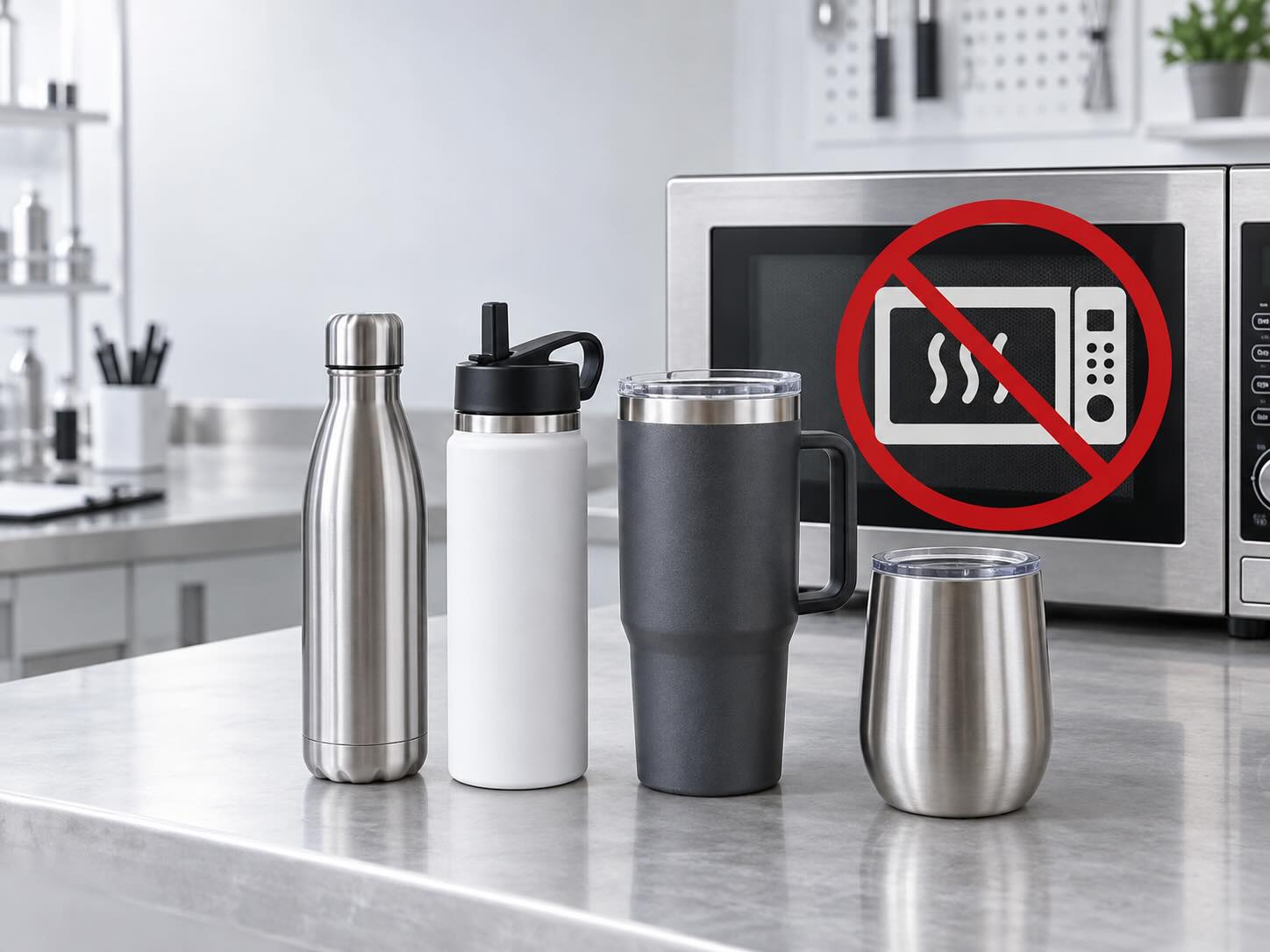
Why Can’t Stainless Steel Drinkware Go in a Microwave?
Microwave ovens heat food by transferring energy into water molecules. Metal behaves differently because it reflects microwave energy instead of allowing it to pass through normally.
The U.S. Food and Drug Administration explains that microwaves are reflected by metal but can pass through materials such as glass, paper, ceramic and certain plastics.
Putting a stainless steel bottle or tumbler in a microwave may cause:
- Electrical arcing or sparks
- Uneven beverage heating
- Damage to the microwave
- Discoloration or damage to the drinkware
- Burns when handling the container or liquid
- Fire risk in serious cases
Vacuum insulation is not the main reason these products cannot be microwaved. The immediate problem is their metal construction.
Can You Microwave a Hydro Flask?
No. A stainless steel Hydro Flask should not be microwaved.
Hydro Flask’s product instructions state that its stainless steel drinkware is not suitable for microwave use. For example, the official Hydro Flask product instructions say not to use the product on a stove, in a microwave or in a freezer.
Heat the beverage in a microwave-safe container first, and only transfer it after confirming that the Hydro Flask model is suitable for hot drinks.
Can You Microwave an Owala Bottle?
No. Owala bottles should not be microwaved.
According to the official Owala FAQ, stainless steel Owala bottles should never be microwaved.
Owala also strongly discourages microwaving its Tritan plastic bottles. A closed or leak-resistant container may allow pressure to build during heating, causing the lid or cap to open unexpectedly.
Some Owala FreeSip bottles are intended mainly for cold water and are not designed for hot liquids. Check the care guide for the exact model before changing its intended use.
Can You Microwave a Stanley Cup?
No. Stanley cups and bottles are not microwave-safe.
The official Stanley FAQ states that its products should not be placed in a microwave because this may damage both the product and the appliance.
For compatible hot-drink products, Stanley recommends preheating the container with warm tap water before filling it. This can improve heat retention without exposing the cup to microwave energy.
Can You Microwave a YETI Cup?
No. YETI Rambler drinkware should never be microwaved.
YETI’s official Rambler FAQ warns that putting Rambler vessels in a microwave may cause fire or personal injury.
This also applies to ceramic-lined products when the structure beneath the ceramic lining is stainless steel. A ceramic coating does not turn a metal cup into a microwave-safe container.
Does Removing the Lid Make the Cup Microwave-Safe?
No. Removing the lid may reduce certain pressure-related risks, but it does not change the stainless steel body.
A metal bottle or tumbler must remain outside the microwave—with or without its lid, straw, gasket or handle.
Do not microwave a plastic lid separately unless the manufacturer specifically identifies it as microwave-safe. Seals, valves, decorative components and gaskets may respond differently to heat.
Does Dishwasher-Safe Mean Microwave-Safe?
No. They are separate product claims.
Dishwasher-safe describes resistance to hot water, detergent and repeated cleaning cycles. Microwave-safe describes how a material behaves when exposed to microwave energy.
A powder-coated stainless steel tumbler may pass a dishwasher-resistance test and still be completely unsuitable for microwave use.
What Is the Safest Way to Heat a Drink?
Follow these steps:
- Pour the beverage into a microwave-safe glass or ceramic container.
- Heat it in short intervals.
- Stir between intervals to reduce uneven heating.
- Let the beverage stand briefly after heating.
- Carefully transfer it into drinkware approved for hot beverages.
- Follow the lid and maximum-temperature instructions for that product.
The USDA microwave safety guidance recommends using cookware manufactured and labeled for microwave use.
For tea, coffee or water, an electric kettle or coffee maker may be a safer and simpler option.
What Should You Do After Accidentally Microwaving a Metal Cup?
If you see sparks or notice smoke, unusual noise or a burning smell:
- Stop the microwave immediately.
- Do not reach inside while arcing is occurring.
- Allow the cup and beverage to cool.
- Inspect the microwave interior, door and seals.
- Check the cup for deformation, coating damage or separated parts.
- Stop using either product if damage is visible.
If the microwave door, hinges, latch or seals appear damaged, discontinue use and contact the appliance manufacturer.
What Should Drinkware Brands Put on Their Packaging?
For private-label and promotional drinkware, care instructions should be confirmed before mass production.
A basic stainless steel drinkware warning may state:
Do not microwave. Heat beverages separately in a microwave-safe container. Follow the product instructions for hot liquids, lid use and cleaning.
Brand buyers should also confirm:
- Whether the product is intended for hot drinks, cold drinks or both
- Maximum recommended beverage temperature
- Whether the lid must remain open when filling hot liquids
- Dishwasher and hand-washing instructions
- Straw, valve and gasket restrictions
- Warning placement on the bottle, insert, box and online listing
- Required warning languages for each target market
Care statements must match the actual bottle, lid and material configuration. A generic warning cannot replace product-specific testing and compliance review.
Buyers can review TOPNOVO’s water bottle quality-control process and learn how to test insulated bottles before bulk production.
Developing Custom Stainless Steel Drinkware?
Microwave warnings should be determined during product specification and packaging approval—not added after production.
A practical sourcing process is:
Select the product → confirm beverage use → approve materials and lid structure → review warnings → test samples → approve packaging → start mass production
Explore TOPNOVO’s custom stainless steel water bottle manufacturing and stainless steel tumbler manufacturing capabilities.
When requesting a quote, provide your target market, product type, capacity, lid design, intended beverage use, quantity and packaging requirements. Use our custom drinkware RFQ checklist to prepare the information needed for an accurate quotation.
Frequently Asked Questions
Can insulated cups go in the microwave?
Not when they contain stainless steel or another metal. Check the product material and manufacturer’s care instructions.
Can I microwave a stainless steel tumbler for a few seconds?
No. A short heating time does not make stainless steel microwave-safe.
Is a ceramic-lined stainless steel cup microwave-safe?
No. If the underlying structure is stainless steel, the cup should not be microwaved.
Can an Owala plastic bottle go in the microwave?
Owala strongly discourages microwaving its Tritan plastic bottles because heat and pressure may create safety risks.
Can I pour a microwaved drink into an insulated cup?
Yes, if the insulated cup is approved for hot beverages. Check its temperature limit, lid design and usage instructions first.
Hydro Flask, Owala, Stanley and YETI are trademarks of their respective owners. TOPNOVO is not affiliated with these brands. Brand names are used only to explain publicly available product-care guidance.