

The right water bottle lid depends on your target customer, usage scenario, drinking style, leak-proof requirements, cleaning experience, product positioning, and customization plan.
For most brands, the best lid is not necessarily the newest or most visually attractive option. It is the lid that:
- Matches the intended use
- Fits the bottle body correctly
- Provides a comfortable drinking experience
- Meets the required leakage standard
- Is easy to clean and maintain
- Supports the target retail price
- Can be produced consistently at scale
A straw lid is convenient for desk use, driving, fitness, and large-capacity tumblers. A screw lid is often more suitable for travel and outdoor bottles where leak resistance is the priority. Flip lids provide convenient daily hydration, while chug lids support faster drinking during sports and outdoor activities.
For private label and OEM drinkware projects, the lid should be confirmed early in product development. Lid selection affects tooling cost, product performance, packaging, quality control, return rates, and customer reviews.
At Topnovo, we help brands, Amazon sellers, wholesalers, and promotional buyers develop custom stainless steel water bottles, tumblers, travel mugs, shaker bottles, and kids bottles with practical lid options, logo customization, sampling, quality control, and bulk production support.
Why Water Bottle Lid Selection Matters
Many buyers spend most of their time choosing the bottle shape, capacity, color, coating, and logo. These details are important, but the lid is often the component customers interact with most frequently. They open it, close it, drink from it, carry it, clean it, and rely on it to prevent leakage.
A bottle may have excellent insulation, attractive powder coating, and premium packaging. But if the lid leaks inside a bag, feels uncomfortable to use, traps odors, or breaks after repeated use, the overall customer experience fails.
For B2B buyers, lid selection can affect:
- Leak-proof performance
- Drinking comfort
- Ease of cleaning
- Product safety
- Replacement-part planning
- Packaging protection
- Amazon return and review risk
- Custom tooling investment
- Long-term brand reputation
This is especially important for Amazon sellers, retail brands, promotional gift companies, sports brands, outdoor businesses, and children’s product buyers.
If you are developing custom stainless steel water bottles, lid selection should be reviewed together with bottle size, mouth diameter, silicone seal, packaging method, and final use scenario.
Water Bottle Lid Comparison
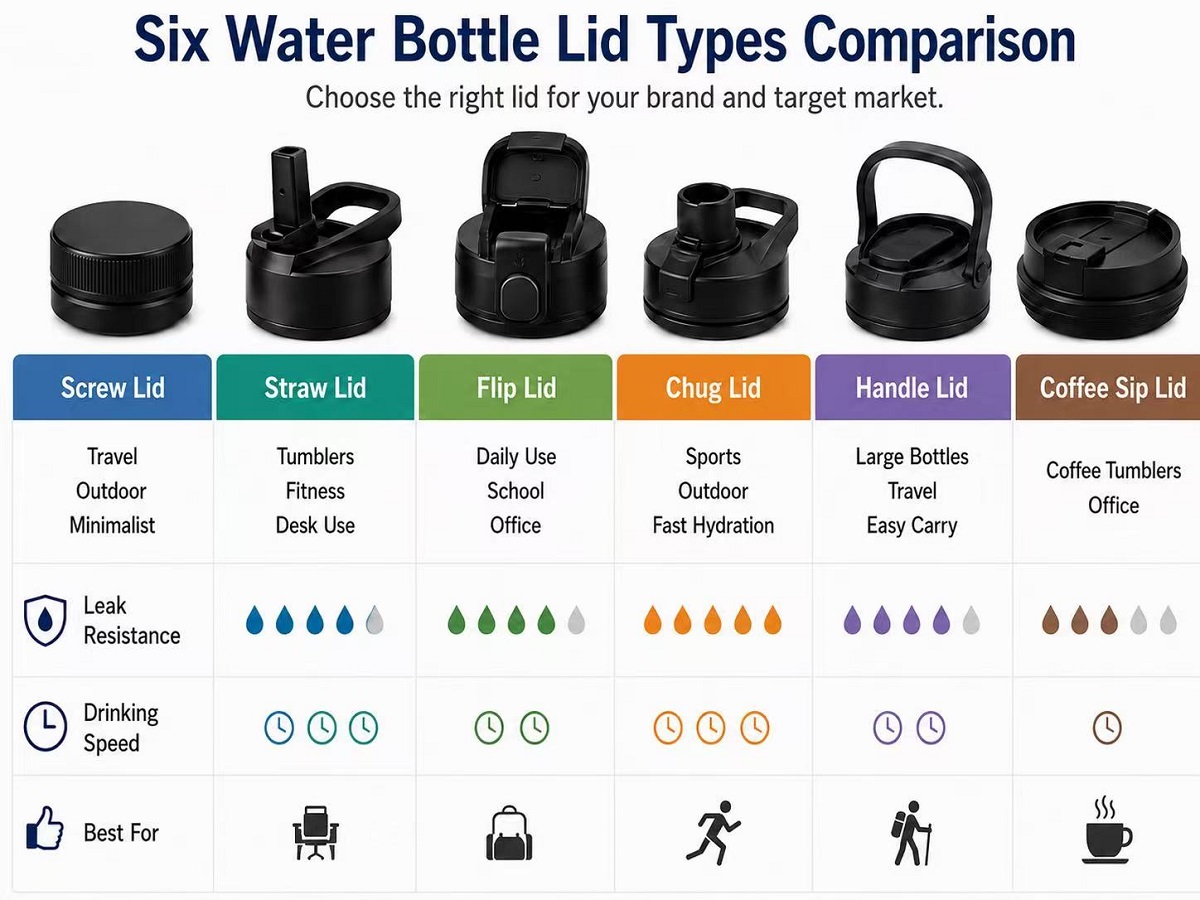
| Lid Type | Best For | Main Advantage | Main Consideration |
|---|---|---|---|
| Screw lid | Travel, hiking, premium bottles | Strong leak resistance | Usually requires two hands |
| Straw lid | Tumblers, fitness, desk use | Easy frequent sipping | More components to clean |
| Flip lid | Daily hydration, office, school | Convenient opening | Hinge and button durability |
| Chug lid | Sports and outdoor bottles | Faster water flow | Flow control and sealing |
| Handle lid | Large bottles and travel bottles | Easy carrying | Handle strength |
| Coffee sip lid | Travel mugs and coffee tumblers | Suitable for hot-drink use | Often splash-resistant, not fully leak-proof |
Common Water Bottle Lid Types
Screw Lid
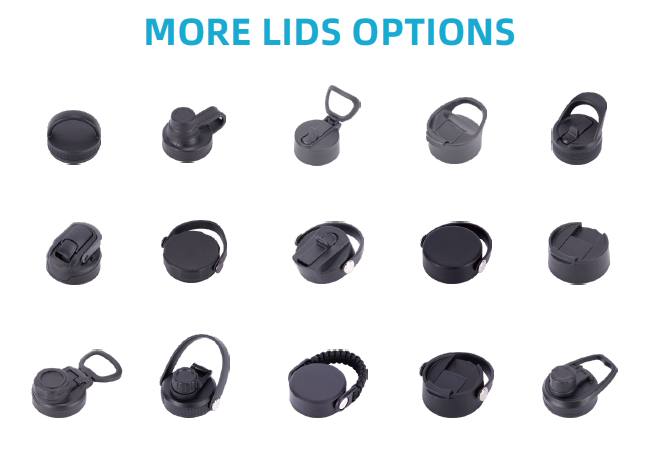
A screw lid opens and closes by twisting. It normally has fewer moving components than straw, flip, or push-button lids.
Best for:
- Travel bottles
- Hiking and outdoor bottles
- Minimalist stainless steel bottles
- Premium gift bottles
- Bottles carried inside bags
Main advantages:
- Strong leak resistance
- Simple and durable structure
- Lower component-failure risk
- Easy to clean
- Suitable for many hot- and cold-drink applications
Buyer considerations:
- Usually requires two hands
- Slower than a straw or flip lid
- Less convenient while driving or exercising
For brands that prioritize durability, simplicity, and low leakage risk, a proven screw lid is often a reliable choice.
Straw Lid
A straw lid allows the user to drink without tilting the bottle. It is widely used for large-capacity tumblers, fitness bottles, kids bottles, and lifestyle hydration products.
Best for:
- 30 oz, 40 oz, and 50 oz tumblers
- Gym and fitness bottles
- Desk hydration
- Driving and commuting
- Kids bottles
- Lifestyle drinkware brands
Main advantages:
- Convenient one-handed drinking
- Comfortable for frequent sipping
- Strong consumer appeal
- Suitable for large-capacity drinkware
- Works well for cold beverages
Buyer considerations:
- More parts must be cleaned
- Straw length must match the bottle capacity
- The mouthpiece, gasket, and air vent require careful testing
- Not all straw lids are completely leak-proof
- Usually not recommended for very hot liquids
For large-capacity drinkware, straw lids can increase perceived product value. For example, a 40oz or 50oz insulated tumbler with a sip and straw lid can work well for commuting, office use, road trips, and all-day hydration.
Flip Lid
A flip lid normally opens through a hinge, button, lock, or thumb tab. It provides a practical balance between convenience and everyday usability.
Best for:
- Daily water bottles
- School bottles
- Office bottles
- Sports bottles
- Promotional drinkware
Main advantages:
- Convenient opening
- Good drinking speed
- Suitable for one-handed use
- Modern appearance
- Broad market acceptance
Buyer considerations:
- Hinge strength must be tested
- Buttons and locking structures need repeated-use testing
- Silicone seals must remain stable after long-term use
- Poor fitting may cause leakage after impact
Flip lids are suitable for brands targeting everyday hydration, but buyers should pay close attention to hinge durability and sealing performance.
Chug Lid
A chug lid has a wider drinking opening than a straw lid, allowing users to drink more quickly.
Best for:
- Gym bottles
- Sports hydration
- Outdoor bottles
- Hiking products
- Large-capacity bottles
Main advantages:
- Fast water flow
- Easy to use during physical activity
- Easier to clean than many straw lids
- Often suitable for wide-mouth bottles
Buyer considerations:
- Flow rate should feel comfortable
- The drinking edge should be smooth
- The closure must still pass leakage testing
- It may not be the best option for young children
For active-lifestyle and outdoor brands, a chug lid can provide a simpler and more durable alternative to a straw lid.
Handle or Carry-Loop Lid
A handle lid or carry-loop lid makes the bottle easier to transport. It is common on outdoor bottles, school bottles, travel bottles, and large-capacity drinkware.
Best for:
- Outdoor bottles
- Student bottles
- Travel bottles
- Large-capacity bottles
- Corporate gift products
Main advantages:
- Better portability
- Easier to carry when the bottle is full
- Can be attached to some bags or equipment
- Adds practical and perceived value
Buyer considerations:
- The handle must support the weight of a filled bottle
- Thin plastic connection points may break
- Handle size may affect packaging efficiency
- Pull, drop, and repeated-use tests may be required
A carry handle may appear simple, but weak structure or poor material selection can create significant after-sales risk.
Coffee Sip Lid
Coffee sip lids are commonly used for travel mugs and tumblers. They may include a sliding cover, rotating closure, push opening, or small drinking slot.
Best for:
- Travel mugs
- Coffee tumblers
- Office drinkware
- Corporate gifts
- Retail coffee products
Main advantages:
- Familiar drinking experience
- Suitable for hot-beverage products
- Convenient for office and commuting use
- Often compatible with car cup holders
Buyer considerations:
- The lid should reduce splash risk
- Sliding parts must be durable
- Hidden grooves may be difficult to clean
- Many sip lids are splash-resistant rather than fully leak-proof
Brands should clearly distinguish between leak-proof and splash-resistant in product descriptions and packaging.
Leak-Proof vs Splash-Resistant: What Buyers Should Know
One of the most common lid misunderstandings is the difference between “leak-proof” and “splash-resistant.”
A leak-proof lid should prevent liquid from escaping when the bottle is closed, inverted, shaken, or carried inside a bag under normal use conditions. A splash-resistant lid is designed to reduce spills during drinking or movement, but it may not be safe to place inside a backpack or handbag.
This matters because many coffee sip lids and tumbler straw lids are not designed to be fully leak-proof. If a buyer markets a splash-resistant lid as leak-proof, the product may receive complaints, returns, or negative reviews.
Before confirming a lid, ask your manufacturer:
- What exact leakage test was performed?
- Was the lid tested with the final bottle body?
- Was the bottle tested upright, inverted, and shaken?
- Was the test performed with room-temperature water or hot liquid?
- Is the lid leak-proof when the straw is inserted?
- Is it leak-proof only when the drinking opening is fully closed?
For Amazon sellers, this distinction is especially important. Topnovo supports Amazon FBA water bottle sellers with product selection, packaging, labeling, and quality control, because reducing avoidable returns starts before bulk production.
How to Choose a Lid by Buyer Type
For Amazon Sellers
Amazon sellers should prioritize low return risk, clear product functionality, and easy cleaning.
Suitable options:
- Straw lids for large tumblers
- Flip lids for daily-use bottles
- Screw lids for travel bottles
- Dual-lid sets for higher-value listings
Questions to confirm:
- Is the lid fully leak-proof or only splash-resistant?
- Can all components be removed and cleaned?
- Are replacement straws and gaskets available?
- Will the lid remain protected during FBA shipping?
- Has the final bottle-and-lid combination been tested?
One lid failure can lead to repeated negative reviews. Samples should always be tested before bulk production.
For Retail Brands
Retail products require consistent appearance, intuitive functionality, and reliable shelf presentation.
Suitable options:
- Flip lids for mass-market hydration
- Straw lids for lifestyle drinkware
- Coffee sip lids for tumblers
- Screw lids for minimalist premium bottles
Questions to confirm:
- Does the lid color match the bottle and packaging?
- Does the lid feel smooth and stable when used?
- Can consumers understand the function immediately?
- Does the packaging show the drinking function clearly?
- Can the supplier maintain consistent quality across repeat orders?
For Corporate and Promotional Gift Buyers
Promotional drinkware should be reliable, practical, and easy for a wide range of users.
Suitable options:
- Screw lids
- Flip lids
- Coffee sip lids
- Carry-handle lids
Questions to confirm:
- Is the lid easy to use without instructions?
- Is it suitable for the intended event or audience?
- Can the lid or bottle support logo customization?
- Can the product be packed in a retail or gift box?
- Is the structure simple enough for bulk distribution?
For corporate gifts, a proven lid structure is usually safer than a complex new design. If branding is important, you can combine a stable lid with custom logo water bottles using screen printing, laser engraving, digital printing, heat transfer printing, or other logo decoration methods.
For Kids Bottle Buyers
Kids bottles require additional attention to safety, cleaning, leakage, and component security.
Suitable options:
- Straw lids with locking functions
- Flip lids with safety closures
- Carry-handle lids
Questions to confirm:
- Are the plastic, straw, and silicone materials suitable for food contact?
- Are small parts securely fixed?
- Can parents remove and clean the components?
- Does the lid remain sealed after dropping?
- Is the mouthpiece comfortable for the intended age group?
For the U.S. market, children’s products may require additional testing and certification depending on the product design and applicable rules. Buyers can refer to the U.S. Consumer Product Safety Commission’s guidance on the Children’s Product Certificate when planning kids bottle projects.
For Outdoor and Sports Brands
Outdoor and sports users generally care about durability, portability, fast hydration, and one-handed operation.
Suitable options:
- Chug lids
- Screw lids
- Carry-handle lids
- Sport flip lids
Questions to confirm:
- Can the lid withstand impact?
- Can the handle support a full bottle?
- Is the product easy to use during activity?
- Does the lid remain sealed after shaking and inversion?
- Can the components be cleaned easily after outdoor use?
Plastic Lid or Stainless Steel Lid: Which Is Better?
Many stainless steel bottles use plastic lids. This is normal because a well-designed plastic lid can provide important functional advantages.
Plastic lids are commonly used because they are:
- Lightweight
- Suitable for complex molding
- Cost-effective for mass production
- Less likely to transfer heat
- Compatible with buttons, handles, straws, and locks
- Available in many colors
Stainless steel lids can create a more premium appearance, but they may be:
- Heavier
- More expensive to process
- Less suitable for complex functions
- More likely to transfer heat
- Limited in color and structural flexibility
For many insulated bottles, a high-quality plastic lid combined with an appropriate food-contact silicone seal is the most practical option.
The key question is not simply whether the lid is plastic or metal. Buyers should evaluate whether the material is:
- Appropriate for food contact
- Durable enough for repeated use
- Suitable for the intended temperature
- Resistant to odor
- Stable during production
- Tested with the final bottle body
For U.S. market planning, buyers can review FDA information about Packaging & Food Contact Substances. For EU market planning, buyers can refer to the European Commission’s guidance on Food Contact Materials. If products are sold in California, buyers should also consider California Proposition 65 requirements.
Lid Quality Control Checklist

Before approving a lid for mass production, buyers should request practical testing with the final bottle body.
| Test Item | What to Check | Why It Matters |
|---|---|---|
| Leakage test | Inversion, shaking, and pressure conditions | Reduces leakage complaints |
| Thread fitting | Smooth opening, closing, and alignment | Prevents poor sealing |
| Silicone gasket | Position, material, and tightness | Critical for leak resistance |
| Straw system | Length, airflow, seal, and drinking flow | Prevents poor drinking performance |
| Hinge or button | Repeated opening and closing | Checks durability |
| Handle strength | Pull strength with a filled bottle | Prevents carrying failure |
| Odor inspection | Plastic and silicone smell | Protects user experience |
| Cleaning review | Hidden grooves and removable parts | Reduces hygiene concerns |
| Drop simulation | Lid performance after impact | Evaluates practical durability |
| Packaging test | Protection inside retail and shipping cartons | Prevents deformation and scratching |
Topnovo’s water bottle quality control process covers raw material checks, production inspection, thermal performance testing, coating inspection, logo inspection, packing checks, and shipping protection. For lid-related projects, leakage testing, component fitting, gasket inspection, and packaging protection are especially important.
Existing Lid or Custom Lid?
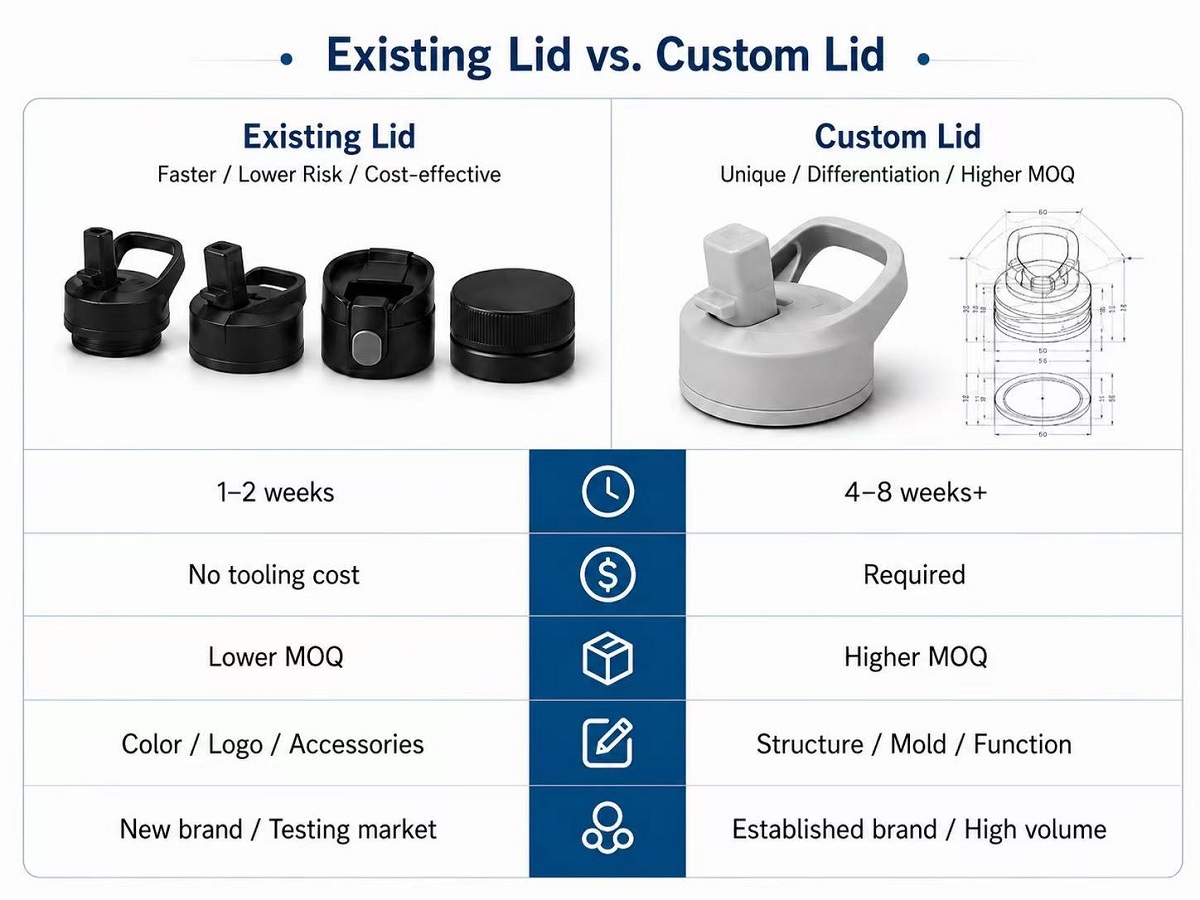
Not every brand needs to invest in a new lid mold. For many new products, an existing and proven lid is the safer and more efficient choice.
Choose an existing lid when:
- You want faster development
- You are testing a new market
- Your initial order is limited
- You do not require a unique function
- You want lower tooling risk
- You want to use a proven structure
Brands can still create differentiation through:
- Custom colors
- Logo decoration
- Bottle shape
- Surface coating
- Packaging
- Accessories
- Product combinations
Consider a custom lid when:
- A unique function is essential
- The bottle requires a special lid fit
- Stronger brand differentiation is needed
- The expected sales volume supports mold investment
- The project requires an exclusive structure
- The product is positioned in a premium market
For startup brands, a practical strategy is often to begin with a proven bottle and lid combination. After sales performance is validated, the brand can consider investing in exclusive molds or patented functions.
If your project requires special lid structure, custom mold development, or full OEM support, Topnovo’s custom water bottle OEM service can support design review, prototyping, tooling setup, sample approval, and scalable production.
Lid Customization Options
Common customization options include:
- Lid color matching
- Logo printing
- Embossed or debossed branding
- Custom silicone colors
- Custom straw colors
- Handle-shape development
- Metal-part laser engraving
- Replacement accessory sets
- Instruction cards
- Retail or gift packaging
- Custom mold development
The right combination depends on the target retail price, order quantity, market positioning, and development budget.
Common Lid Problems and Prevention
Leakage
Possible causes:
- Poorly fitted silicone gasket
- Incorrect thread tolerance
- Unstable air-vent structure
- Improper straw-hole sealing
- Lid deformation
Prevention:
- Test the final lid with the final bottle body
- Confirm pre-production samples
- Conduct inversion and shaking tests
- Inspect gasket positioning
- Protect lids properly during shipping
Plastic or Silicone Odor
Possible causes:
- Unsuitable raw materials
- Poor-quality silicone
- Insufficient airing after production
- Packaging too soon after manufacturing
Prevention:
- Confirm material specifications
- Request odor inspection
- Test final production samples
- Allow appropriate ventilation before packaging
Poor Straw Performance
Possible causes:
- Incorrect straw length
- Unbalanced air vent
- Poor mouthpiece design
- Mismatch between the straw and bottle capacity
Prevention:
- Confirm the correct straw length for each capacity
- Test drinking flow with the intended liquid
- Check comfort and airflow
- Consider replacement straws where appropriate
Broken Buttons, Hinges, or Handles
Possible causes:
- Plastic components that are too thin
- Weak connection points
- Unsuitable material toughness
- Lack of repeated-use testing
Prevention:
- Conduct repeated opening and closing tests
- Review hinge and handle thickness
- Perform pull and drop tests
- Avoid unnecessary complexity in entry-level products
Difficult Cleaning
Possible causes:
- Too many hidden grooves
- Non-removable silicone components
- Narrow internal channels
- Complex lid structures
Prevention:
- Choose detachable components where possible
- Review the lid from a cleaning perspective
- Provide clear care instructions
- Offer replacement gaskets or straws when needed
Questions to Ask Your Manufacturer
Before confirming a bulk order, ask your supplier:
- Is this lid already used in mass production?
- Which bottle bodies and capacities does it fit?
- Is it suitable for hot drinks, cold drinks, or both?
- What materials are used for the lid, gasket, and straw?
- Has the lid been tested with this exact bottle body?
- Is it fully leak-proof or splash-resistant?
- Can the color and logo be customized?
- Are replacement components available?
- What is the MOQ for the existing lid?
- What are the tooling cost and lead time for a custom lid?
- Which testing or compliance documents can be arranged?
- How will the lid be protected during packaging and shipping?
A reliable manufacturer should provide clear answers based on the actual product structure rather than making general promises.
Topnovo’s Recommendation
For most brands, the safest approach is to start with the main usage scenario:
| Product Scenario | Recommended Lid |
|---|---|
| Travel bottles | Screw lid or carry-handle screw lid |
| Large tumblers | Straw lid with reliable sealing and easy cleaning |
| Sports bottles | Chug lid or sport flip lid |
| Office bottles | Flip lid or straw lid |
| Coffee tumblers | Sip lid with clearly defined splash or leak resistance |
| Kids bottles | Straw or flip lid with safety lock and easy-cleaning structure |
| Outdoor bottles | Durable screw, chug, or carry-handle lid |
Do not choose a lid based only on appearance.
A visually attractive lid that fails during daily use can damage product reviews and brand trust. A simpler, proven lid that works consistently may create greater long-term value.
Before bulk production, we recommend confirming samples, testing the exact lid and bottle combination, checking packaging protection, and reviewing compliance needs for your target market. You can request a custom water bottle sample from Topnovo before moving into mass production.
FAQ
What is the most leak-proof water bottle lid?
A screw lid is usually one of the most reliable options because it has a simple structure and fewer moving parts. However, leak-proof performance depends on the exact bottle body, thread tolerance, silicone gasket, and testing standard. Always test the final lid with the final bottle body.
Are straw lids suitable for hot drinks?
Straw lids are generally better for cold drinks. Hot liquids may create pressure, increase burn risk, or affect user safety. For coffee or tea products, a coffee sip lid is usually more appropriate, but buyers should confirm whether it is leak-proof or only splash-resistant.
Should I choose a plastic lid or stainless steel lid?
For most insulated bottles, a high-quality plastic lid with a food-contact silicone seal is practical because it is lightweight, easier to mold, and suitable for complex structures such as buttons, handles, straws, and locking mechanisms. Stainless steel lids can look premium but are less flexible for complex lid functions.
Do I need a custom lid mold for my brand?
Not always. If you are testing the market or launching your first order, an existing proven lid is often safer and faster. A custom lid mold makes sense when you need a unique function, exclusive structure, special fit, or premium product positioning with enough order volume to support tooling investment.
How do manufacturers test water bottle lids?
Common tests include inversion testing, shaking testing, thread fitting checks, silicone gasket inspection, straw flow testing, repeated hinge or button opening tests, handle pull testing, odor inspection, drop simulation, and packaging protection checks.
Which lid is best for Amazon sellers?
For Amazon sellers, the best lid is one that is easy to understand, easy to clean, clearly described in the listing, and tested to reduce return risk. Straw lids work well for large tumblers, flip lids work well for daily bottles, and screw lids work well for travel bottles.
Final Thoughts
Choosing a water bottle lid is not a minor design decision.
The lid directly affects product performance, user experience, leakage risk, cleaning convenience, packaging, customer reviews, development cost, and brand reputation.
The right lid should match the bottle body, target user, drinking scenario, retail price, and customization plan. It should also be tested with the final product before mass production.
Topnovo supports brands, Amazon sellers, wholesalers, retailers, and promotional buyers with OEM and ODM stainless steel drinkware development, including bottle selection, lid matching, customization, sampling, quality control, packaging, and bulk production.
Planning a custom water bottle project?
Share your target market, bottle capacity, preferred lid style, order quantity, and packaging requirements with our team. We can recommend suitable existing lid options or help evaluate whether a custom lid is necessary.