
For most stainless steel water bottles, powder coating is the better choice when durability, grip, scratch resistance, and lower after-sales risk matter most. It is especially suitable for sports bottles, outdoor bottles, school bottles, Amazon products, promotional gifts, and daily-use tumblers.
Spray painting is better when the brand needs a smoother, glossier, more decorative, or more flexible visual finish, such as metallic effects, gradients, pearl finishes, soft pastel colors, or fashion-focused gift collections.
For B2B buyers, the finish choice should not be based only on appearance. A good surface finish should reduce customer complaints, protect the brand image, support the logo method, survive shipping, and match the expected retail price.
At Topnovo, we help brands, wholesalers, Amazon sellers, and promotional buyers choose the right coating before sampling and bulk production, so the finish supports both product performance and business goals.
Why Surface Finish Matters
Surface finish is one of the first things customers notice when they pick up a bottle. It affects appearance, hand feel, grip, durability, logo performance, packaging protection, and customer reviews.
For B2B buyers, the wrong finish can create real business problems:
- Scratches during shipping
- Paint chipping after daily use
- Color inconsistency between batches
- Logo adhesion problems
- Higher Amazon return rates
- Poor retail shelf appearance
- More customer complaints
- Extra packaging cost
A stainless steel bottle may have good insulation and a strong lid, but if the coating scratches easily, the product can feel cheap. In real production, many coating problems are not caused by the finish type alone. They often come from poor surface cleaning, unstable curing temperature, weak primer, wrong logo matching, or insufficient packaging protection.
That is why powder coating and spray painting should be evaluated as part of the whole product strategy, not just as decoration.
What Is Powder Coating?

Powder coating is a dry finishing process. Fine powder particles are applied to the stainless steel bottle surface, usually through electrostatic spraying, and then cured with heat. During curing, the powder melts and forms a hard coating layer.
Powder coating is widely used for stainless steel water bottles and tumblers because it creates a durable, textured, and grip-friendly surface. It is especially useful for products that need to handle daily use, repeated washing, outdoor activities, and bulk shipping.
Best For
- Sports bottles
- Outdoor bottles
- Daily-use tumblers
- School bottles
- Amazon products
- Corporate gift bottles
- Mass-market collections
- Bottles requiring stronger grip
- Products with laser engraved logos
Main Advantages
- Strong scratch resistance
- Better grip and hand feel
- Good durability for daily use
- Lower risk of peeling when properly cured
- Stable matte or textured appearance
- Better shipping tolerance
- Strong compatibility with laser engraving
- Lower long-term after-sales risk
Main Limitations
- Fewer glossy or metallic effects than spray painting
- Some textures may show a light orange-peel effect
- Custom powder colors may require higher MOQ
- Not ideal for complex gradients
- Requires good curing control
What Is Spray Painting?
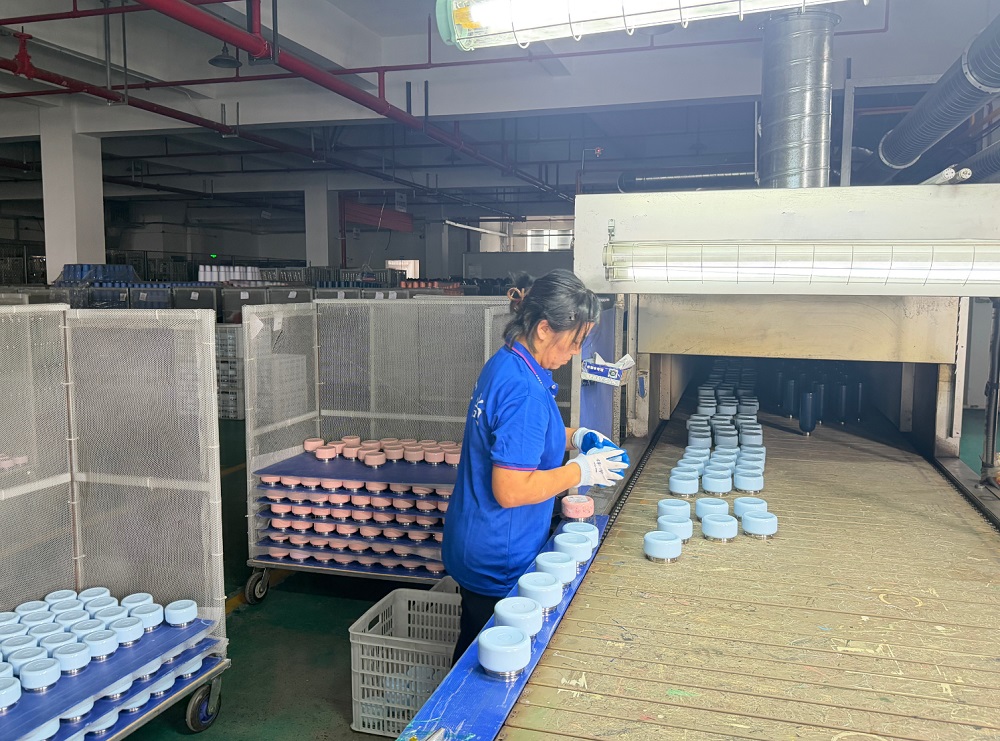
Spray painting uses liquid paint sprayed onto the stainless steel surface. Depending on the required finish, it may involve surface cleaning, primer, color coat, clear coat, and baking or curing steps.
Spray painting gives brands more visual flexibility. It can create smooth, glossy, metallic, pearl, gradient, or soft-touch effects that may be difficult with standard powder coating.
Best For
- Fashion drinkware
- Gift collections
- Boutique retail products
- Metallic or pearl finishes
- Gradient color designs
- Smooth glossy finishes
- Limited edition campaigns
- Products where appearance matters more than rugged use
Main Advantages
- Smooth and refined appearance
- More decorative finish options
- Better for gradients and special effects
- Suitable for glossy, metallic, and pearl finishes
- Flexible for fashion-oriented product lines
- Easier to create visually unique collections
Main Limitations
- Usually easier to scratch than powder coating
- More sensitive to surface preparation
- May require stronger packaging protection
- Adhesion depends heavily on primer and curing
- Higher risk of chipping under rough use
- Some liquid coating systems may involve VOC concerns
For manufacturing environments, OSHA notes that spray painting operations can involve hazards such as toxic materials, flammable vapors, mists, and particulates, so ventilation, process control, and worker protection are important.
Powder Coating vs Spray Painting: Comparison Table
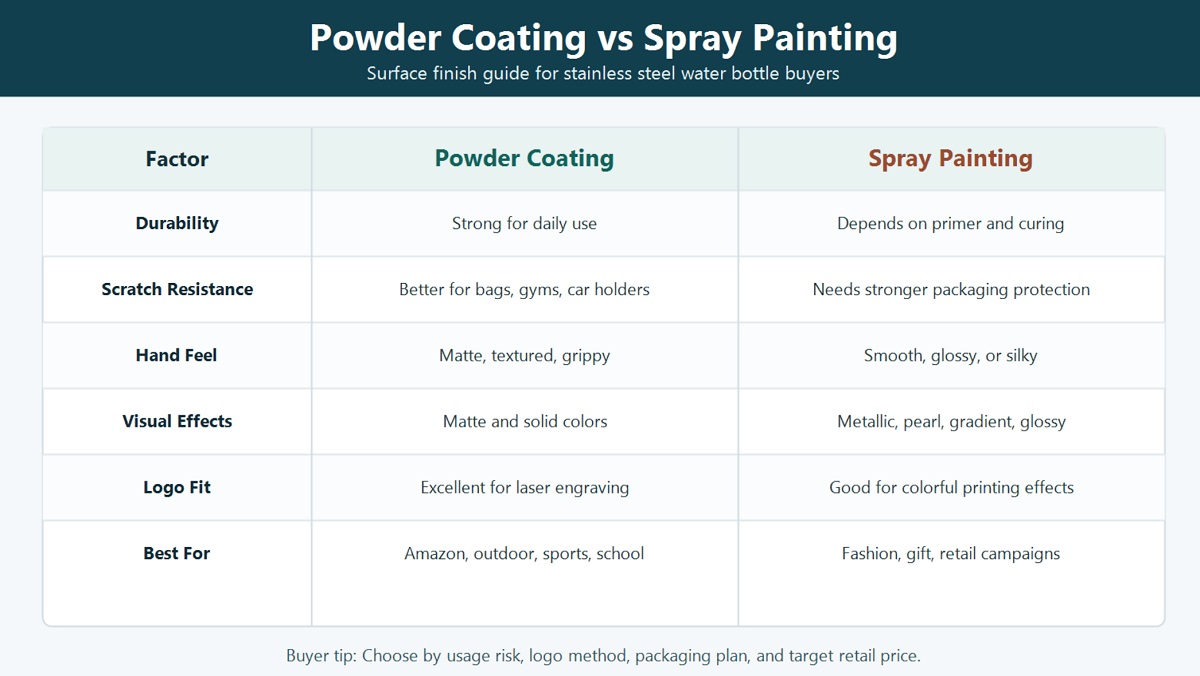
| Factor | Powder Coating | Spray Painting |
|---|---|---|
| Durability | Stronger for daily use | Moderate; depends on primer and curing |
| Scratch Resistance | Better | Easier to scratch |
| Hand Feel | Textured, matte, grippy | Smooth, glossy, or silky |
| Visual Effects | Matte, textured, solid colors | Metallic, pearl, gradient, glossy |
| Shipping Risk | Lower | Higher; needs better protection |
| Logo Compatibility | Excellent for laser engraving and simple printing | Good for printing and decorative effects |
| Color Consistency | Stable for standard colors | Flexible but needs careful control |
| MOQ Flexibility | May be higher for custom powder colors | Often more flexible for fashion colors |
| Environmental Profile | Often lower VOC; powder overspray may be recoverable | Solvent-based systems may involve VOC concerns |
| Best For | Sports, outdoor, Amazon, daily use | Gift, fashion, retail, visual campaigns |
The EPA lists powder coatings among examples of low- or no-VOC/HAP coating systems, while liquid coating systems may require more attention to solvent content, emissions, and documentation depending on the formulation.
Which Finish Is More Durable?
In most daily-use drinkware projects, powder coating is more durable than spray painting.
Powder coating usually forms a thicker and harder surface layer. It performs better when bottles are carried in bags, used at gyms, placed in car cup holders, handled by students, or shipped in bulk cartons.
Spray painting can still be suitable, but durability depends heavily on:
- Surface cleaning
- Primer quality
- Paint formulation
- Coating thickness
- Curing temperature
- Clear coat protection
- Packaging method
- Real-use conditions
A spray-painted bottle can look beautiful in a sample photo but perform poorly if adhesion and packaging are not controlled. For the same finish type, poor surface preparation can cause more problems than the coating method itself.
Choosing by Buyer Type
| Buyer Type | Better Choice | Why |
|---|---|---|
| Amazon sellers | Powder coating | Reduces scratch complaints and return risk |
| Outdoor brands | Powder coating | Better grip and durability |
| Sports brands | Powder coating | Stronger resistance to rough daily use |
| School bottle buyers | Powder coating | More practical for repeated handling |
| Corporate gift buyers | Powder coating or spray painting | Powder for durability; spray painting for premium visual effects |
| Fashion brands | Spray painting | Better for metallic, pearl, gradient, and glossy finishes |
| Retail lifestyle brands | Depends on positioning | Powder for durable daily-use lines; spray painting for decorative collections |
| Promotional buyers | Depends on campaign goal | Powder for long-term use; spray painting for lower-cost visual campaigns |
Choosing by Logo Method
The surface finish also affects logo customization. If you plan to order custom logo water bottles, confirm the finish and logo method together before approving production.
| Logo Method | Powder Coating | Spray Painting |
|---|---|---|
| Laser engraving | Excellent; strong contrast on dark matte colors | Possible, but sample approval is important |
| Screen printing | Works well with proper ink and surface prep | Works well; adhesion testing is important |
| UV printing | Possible, but texture may affect fine detail | Often suitable for colorful visual designs |
| Heat transfer | Depends on coating and temperature tolerance | Often suitable for decorative effects |
| Water transfer | Less common for standard powder coating | Better for complex patterns |
| Sublimation | Requires special coating | Requires special coating |
For powder-coated bottles, laser engraving is often a strong choice because the laser removes the coating and reveals the stainless steel underneath. For spray-painted bottles, full-color printing and decorative effects may look more flexible, but adhesion and scratch testing become more important.
Cost, MOQ, and Lead Time
Buyers should not compare powder coating and spray painting only by unit price. The true cost includes defect rate, packaging requirements, inspection, replacement risk, and after-sales cost.
Powder Coating Cost Factors
- Powder color
- Texture type
- Coating thickness
- Curing process
- Color change setup
- Order quantity
- Logo method
- Packaging protection
Powder coating may have higher setup requirements for custom colors, but it can reduce long-term quality risk for daily-use products.
Spray Painting Cost Factors
- Primer system
- Number of paint layers
- Gloss, metallic, pearl, or gradient effect
- Clear coat requirement
- Drying or baking process
- Labor and inspection requirements
- Protective packaging
Spray painting may be attractive for fashion colors and lower initial cost, but buyers should consider extra QC and shipping protection.
Coating Quality Control Checklist
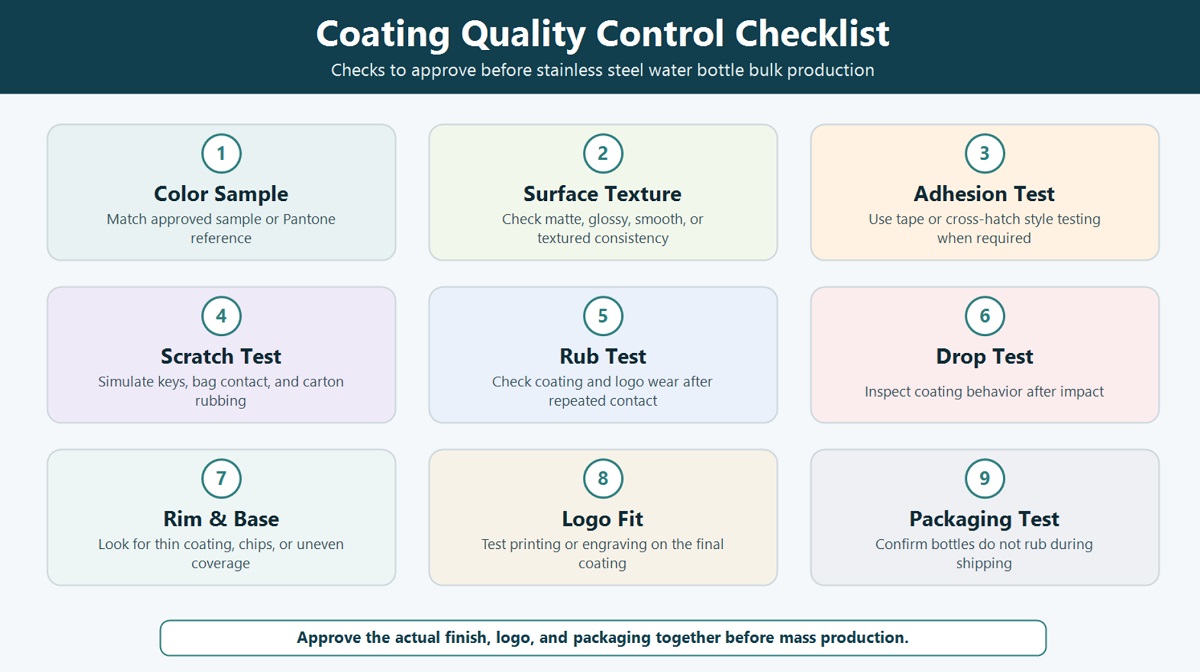
Before approving bulk production, buyers should test the actual coating on the actual bottle body.
| QC Item | What to Check | Why It Matters |
|---|---|---|
| Color Sample | Compare with approved sample or Pantone reference | Prevents batch color disputes |
| Surface Texture | Matte, smooth, glossy, or textured consistency | Ensures correct hand feel |
| Adhesion Test | Tape or cross-hatch style adhesion test where required | Reduces peeling risk |
| Scratch Test | Simulate keys, handling, or carton rubbing | Checks daily-use durability |
| Rub Test | Repeated hand contact or cloth rubbing | Evaluates logo and coating wear |
| Drop Test | Coating behavior after impact | Important for shipping and real use |
| Salt Spray or Corrosion Check | Coating protection near base and rim | Helps evaluate outdoor use risk |
| Rim and Base Inspection | Look for thin coating, chipping, or uneven coverage | Common failure points |
| Logo Compatibility | Test logo on final coating | Prevents printing or engraving issues |
| Packaging Test | Check if bottles rub during shipping | Reduces arrival damage |
ASTM D3359 is commonly referenced for evaluating coating adhesion by tape test. For buyers, the key point is simple: the coating should stay firmly attached to the stainless steel surface during normal handling, packing, and customer use.
Topnovo’s water bottle quality control process includes checks for coating, painting, logo making, packing, and final shipment protection. This matters because surface finish problems often appear during daily use or transportation, not only during production.
Common Coating Problems and How to Prevent Them
Scratches Before Delivery
Possible causes:
- Weak coating
- Bottles rubbing in cartons
- Poor inner packaging
- Insufficient curing
Prevention:
- Use protective bags or dividers
- Check carton packing
- Perform rub and scratch tests
- Confirm curing standards
Peeling or Chipping
Possible causes:
- Poor surface cleaning
- Weak adhesion
- Incorrect primer
- Impact around the rim or base
Prevention:
- Confirm surface preparation
- Test adhesion
- Inspect base and rim areas
- Use stronger packaging for spray-painted products
Color Difference Between Batches
Possible causes:
- Different powder or paint batches
- Poor color standard control
- Different curing conditions
- Lighting differences during approval
Prevention:
- Approve physical color samples
- Keep color standards
- Confirm tolerance before production
- Use consistent suppliers for repeat orders
Orange Peel or Uneven Texture
Possible causes:
- Powder thickness issue
- Curing problem
- Spray distance variation
- Surface contamination
Prevention:
- Check texture before mass production
- Confirm acceptable sample standard
- Inspect production line output
- Avoid vague descriptions like “matte black” without a physical sample
Logo Adhesion Problems
Possible causes:
- Logo method not matched to coating
- Ink not compatible with surface
- Coating texture too rough
- Insufficient curing before printing
Prevention:
- Test logo on final coating
- Approve decorated sample
- Confirm ink and curing process
- Use laser engraving when durability is the top priority
Topnovo’s Recommendation
For most B2B stainless steel water bottle projects, Topnovo recommends:
Choose powder coating for daily-use bottles, outdoor bottles, sports tumblers, Amazon products, school bottles, and collections where durability matters.
Choose spray painting for fashion-focused bottles, gift sets, glossy finishes, metallic effects, gradients, and products where visual appeal is more important than rugged use.
Choose the coating and logo method together, not separately.
Always approve a physical sample before bulk production.
Test coating adhesion, logo performance, color consistency, and packaging protection before shipment.
If your project requires custom colors, logo printing, packaging, or OEM development, Topnovo can help evaluate the finish during sampling. Buyers can also request a custom water bottle sample before moving into mass production.
FAQ
Is powder coating better than spray painting for stainless steel water bottles?
For most daily-use stainless steel water bottles, powder coating is usually better because it offers stronger scratch resistance, better grip, and lower after-sales risk.
When should I choose spray painting?
Choose spray painting when your product needs a smoother, glossier, metallic, pearl, gradient, or more decorative finish. It is suitable for fashion, gift, and lifestyle drinkware.
Does powder coating affect insulation performance?
No. Powder coating is applied to the outer surface of the bottle. Vacuum insulation depends on the double-wall structure, not the outer coating.
Can laser engraving be used on powder-coated bottles?
Yes. Laser engraving works very well on many powder-coated stainless steel bottles because it removes the coating and reveals the stainless steel underneath.
Which finish is better for Amazon sellers?
Powder coating is usually safer for Amazon sellers because it helps reduce scratch complaints, return risk, and negative reviews related to surface wear.
Should I approve a sample before production?
Yes. A physical sample helps confirm color, texture, coating durability, logo effect, packaging protection, and overall product feel before bulk production.
Final Thoughts
Powder coating and spray painting both have value, but they serve different product strategies.
Powder coating is usually the practical choice for durable, daily-use stainless steel water bottles and tumblers. It is strong, grippy, stable, and better suited for products that need to survive real customer use.
Spray painting is better when the brand needs smooth visual effects, glossy finishes, metallic colors, gradients, or a more decorative look.
The right decision depends on your target market, usage scenario, retail price, logo method, packaging plan, and quality standard.
Planning a custom stainless steel water bottle project? Share your bottle type, target market, color requirement, logo method, order quantity, and packaging needs with Topnovo. Our team can recommend the right surface finish before sampling and bulk production.